Wednesday, March 2, 2016

The illusion of change in Iran


Burhanettin Duran, Daily Sabah

image (not from article) from
Excerpt:
Feb. 26 Iran held elections for the Assembly of Experts, which elects the supreme leader, and for parliament. The fact that millions of Iranians went to the polls for the first time since the nuclear deal raised the election's profile.
According to media reports, moderate reformists affiliated with President Hassan Rouhani and former President Hashemi Rafsanjani won a majority in both houses, which the international community, no doubt, will welcome. ...
To be perfectly honest, Iran's public diplomacy team deserves some credit. Whenever Iran holds elections, they persuade the West that the country is at a critical junction. The fact that Iran has a semi-democratic government under Supreme Leader Ali Khamenei's political and ideological control often goes unnoticed. ...
Athough the lifting of sanctions might trigger economic growth, which the government could use to partially liberalize domestic politics, Iranian foreign policy will remain immune to change. The country abandoned anti-Western rhetoric after the Arab Spring revolutions and opted to strengthen its cooperation with the West while aggressively expanding Iran's influence over the Middle East. ...
The Syrian civil war provided the perfect opportunity for Iran's leaders to test their instruments of hard and soft power. By suggesting that Iranian citizens fighting the Syrian opposition were clashing with infidels, Khamenei tapped into Iran's radical ideology and religious doctrine to legitimize regional competition. At this point, the world is so preoccupied with radical Sunni jihadists embodied by DAESH that many people are willing to turn a blind eye to the Iranian leadership's pragmatism with a radical twist. Moving forward, Iran will seek to work more closely with the United States, the European Union and Russia by tapping into fears of Sunni radicalism. ...

Kazakhstan's First UN Representative Reflects on almost a Quarter Century of Membership


Astana Times

Arystanbekova image from article

Excerpt:
Kazakhstan was admitted to membership in the United Nations (UN) on March 2, 1992. On the eve of the 24th anniversary of such an important event in the country’s international recognition, The Astana Times asked Professor Akmaral Arystanbekova to share her thoughts on the significance of the date. Arystanbekova, Ambassador-at-Large of the Kazakh Ministry of Foreign Affairs, was the nation’s first permanent representative to the UN from 1992-1999. ...
[Q:] Some foreign affairs specialists think that the future of diplomacy is in the hands of its multilateral format. Do you agree with this statement?
[Arystanbekova:] I have the impression that the future of diplomacy is connected to implementation of both multilateral and bilateral formats of diplomatic activities. Indeed, in recent years international academia have been actively discussing the future of diplomacy in world politics. This is connected to the fact that modern globalisation, whose conditions include inclusive transformation of the world order, has an effect on diplomacy as it is a major regulatory tool of international relations in an interdependent world.
Today, the role and importance of multilateral diplomacy is increasing amid the new geopolitical reality, emergence of new non-state actors of world politics and new global issues and security threats which demand joint actions and solutions. It plays a special role in strengthening the international legal base of intergovernmental cooperation.
New formal and informal mechanisms are being created, e.g. the G20 and BRICS (Brazil, Russia, India, China and South Africa). In line with so called “club diplomacy” which assembles various country groups of common interests, the formation process of “network diplomacy,” which refers to development of a flexible network of interactions both between governments and between governments and civil society, is being established.
States place high emphasis on expansion of the “public diplomacy” dedicated to create a positive image of the country in other states in order to influence their policies towards the country. Modern bilateral diplomacy, besides traditional intergovernmental interactions, particularly uses these new forms of diplomatic activities more frequently. Obviously, increasing the role of the so-called Track II diplomacy, which is implemented by representatives of non-governmental structures, and actions of different civil society groups progressively influence the determination of the global agenda.
In my opinion, that is why the modern foreign policy activities of a state must embrace a whole variety of interactions with state and non-state participants in international relations. At the same time, traditional diplomacy, based on intergovernmental relations both in bilateral and multilateral formats, will preserve its paramount importance. ...

U.S., Pak discuss cooperation in science and technology


Business Standard

image from

The United States and discussed cooperation in education, science and technology, which both sides said provides a lasting foundation for ties and serves as an engine for long-term economic growth.
The discussion in this regard took place during the second U.S.-Pakistan Education, Science, and Technology Working Group in D.C. chaired by US Under Secretary of State for Public Diplomacy and Public Affairs Richard Stengel and Pakistan's Minister of Planning, Development and Reform Ahsan Iqbal.
The meeting, which took place prior to the Strategic Dialogue Ministerial, provides a platform to strengthen cooperation under the 'U.S.-Pakistan Knowledge Corridor', focused on advancing academic networks, partnerships and exchanges in higher education, science and technology.
Stengel and Iqbal signed a statement at the meeting recognizing the commitment by Pakistan's Higher Education Commission to fund scholarships for an additional 125 Pakistani PhD students in the United States through the Fulbright Program over the next five years, complementing the U.S. investment in the Fulbright Program in Pakistan, which is the largest worldwide.
Both sides discussed cooperation in education, science and technology through the "U.S.-Pakistan Knowledge Corridor", which provides a lasting foundation for ties and serves as an engine for long-term economic growth.
They reviewed the substantial achievements since the last Working Group held in Islamabad in June 2015: doubling joint funding for collaborative science and technology research grants; launching U.S.-Pakistan Centers for Advanced Studies in energy, water, and agriculture/food security, part of the 23 total U.S.-Pakistan university partnerships; and the announcement of the joint Let Girls Learn initiative to expand educational opportunity for adolescent girls.
At the Working Group, Stengel announced the establishment of a new university partnership between the University of Massachusetts and a consortium of universities in Balochistan.
Iqbal noted his country's aspiration for 10,000 Pakistanis to obtain PhDs at U.S. universities by 2025. The two sides agreed to explore initiatives to expand educational opportunities for Pakistani students in the United States at the tertiary level.
They also recognized that ongoing investments in basic and higher education, including through the Let Girls Learn Initiative, will create a well-educated workforce that will drive innovation, gender equality, and a knowledge-based economy.
The United States lauded Pakistan for doubling its higher education budget since 2013 for its efforts to expand women and girls' access to education, and for pledging to increase spending on education from two to four percent of GDP by 2018.

Tuesday, March 1, 2016

A Call for an EU Auxiliary Navy – under German Leadership


Sebastian Bruns, cimsec.org

Image from article, with caption: Combat support ship Berlin and frigate Hessen steam side by side in the initital provision of humanitarian assistance on the Southern flank.

Excerpt:

Germany could play a leadership role in drawing up a European auxiliary navy, reenergizing the European spirit of cooperation in the process. Such a task force could have a number of political advantages. First, it would send a strong signal that European nations are willing to work together to address the ramifications of maritime trafficking. Second, Germany would address calls from inside and outside to do more. As a maritime nation with strong normative impulses, the Federal Republic would also demonstrate to the electorate (long weary of military engagement) that it is aware of the utility of naval forces in crisis response. Naturally, German investment into an auxiliary EU navy should not come at the expense of more robust naval tasks with the German Navy, but these could be better tailored if the combat support ships, frigates, and corvettes need not be used in lesser operations. Third, if and when the current migrant crisis ebbs, the European auxiliary navy could concentrate on the public diplomacy role of naval forces, providing anything from humanitarian assistance to the provision of medical services on goodwill tours around the world (like the U.S. Navy and the Chinese PLAN routinely do already). This auxiliary navy could also lend a hand to regional coastal and constabulary navies and coast guards (e.g. in West or East Africa) to train and exercise. ...

10 Tech Tools to Up Your Digital Game


uscpublicdiplomacy.org

image from entry
Mar 1, 2016
CPD's new PD Digital series offers a selection of tech tips and tools for 21stcentury public diplomats. Here are 10 useful apps to maximize your digital presence.
BanjoTrack global news in real-time.
BatchgeoDesign customized maps that tell stories.
Capzles: DIY interactive timelines to chronicle events.
Exposure: Create meaningful visual stories to win public support.
Instagram: Share behind-the-scenes images of what moves you.
Kickstarter: Campaign and crowdfund for a global cause.
PeriscopeRecord and share live video with people all over the world
Ripjar: Gauge the impact of your digital presence. 
Snapchat: Share local experiences through photos and videos.
Visualead: Generate QR codes to direct mobile users to your website.
For links to each of the apps above and a running list of all our tech tips, click here.

Broad Influence & The True Impact of Women in Power


Cari E. Guittard, Huffington Post

Excerpt:
Humility, collaboration and behind the scenes hard work is a hallmark of many women in power in DC. I experienced this dynamic firsthand when I worked for Charlotte Beers during her tenure as Under Secretary of State for Public Diplomacy at the State Department post 9/11. Appointed by then Secretary of State Colin Powell to 'Win the Hearts and Minds of the Arab World' Charlotte, an advertising legend from Madison Avenue, worked daily with Condolezza Rice, then National Security Advisor, Karen Hughes, who served as Counsellor to the President and Mary Matalin, Counsellor to the Vice President. Each of these women are truly remarkable, accomplished, forces of nature in their own right and yet they came together to get the work done where they could. It was a sisyphean task on most days. Given the intensity of the post 9/11 environment and the serious implications of nearly every issue that they collectively dealt with, it always amazed me how often the male senior staff would focus and comment on what one of them was wearing on any given day or how their hair looked. As many who have worked there know, Washington, DC is a place where fashion goes to die and conformity is key.
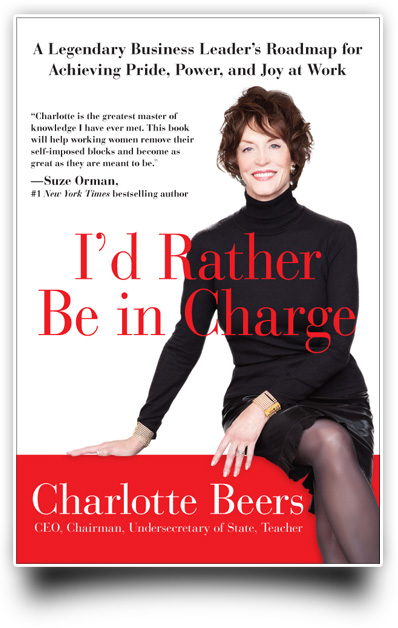
Charlotte, who was in her 60s at the time became known for her unique style that was decidedly Madison Avenue - edgy, feminine, fitted and full of bright colors. She rocked everything she wore and she always said she wore what she felt comfortable and confident in. I remember vividly being regularly asked by male colleagues at the White House what Charlotte was going to wear one day for various press events. "She absolutely cannot wear her black leather skirt. Please make sure she doesn't wear anything too out there." To this day I still don't know what 'too out there' meant and as far as the mini skirt which actually was a couture knee length pencil skirt, I remember responding, "Well if I had Charlotte's legs I'd be wearing the same thing and if you are this concerned with what she is wearing you should tell the Under Secretary directly."My tone was unmistakable. We have work to do. Back the f**l off so we can get on with it. Thankfully, I never heard about that skirt or her wardrobe again. And in true Charlotte fashion she proudly wore a similar leather skirt on the cover of her book, I'd Rather Be in Charge.
2016-02-29-1456787819-6525427-ratherbeincharge1.jpg
...

HELLE DALE Broadcasting Reform At BBG Is Urgently Needed To Fight ISIS


bbgwatch.com

Helle Dale
BBG Watch Media
Helle_Dale_4-15-15
Helle C. Dale, the Heritage Foundation’s senior fellow in public diplomacy, has called for urgent reform of the Broadcasting Board of Governors (BBG).
Last week, another American scholar of public diplomacy and media, Martha Bayles made an unusual public appeal to BBG board members to look to qualified outside candidates for the job of permanent president of Radio Free Europe / Radio Liberty (RFE/RL) because of management problems and low employee morale at RFE/RL.
The House Foreign Affairs Committee called the Broadcasting Board of Governors, which is in charge of all U.S.-funded media outreach oversees, “a broken agency.”
This Broken Agency is Losing the Info War to ISIS & Putin,” a committee press release said last week.
President Obama failed to mention the BBG last week in a statement outlining plans to counter ISIL on the ideological front.
“The U.S. government desperately needs new and better tools to fight the information war against the Islamic State (ISIS) and other terrorist networks,” Helle Dale wrote.
“Once such new tool, The United States International Communications Reform Act (H.R. 2323), which was passed last May by the House Foreign Affairs Committee, remains in waiting mode and is pending a full House vote and Senate action,” the Heritage Foundation’s expert on public diplomacy pointed out in her article in The Daily Signal.


HELLE DALE: “When it comes to reform of the Broadcasting Board of Governors, which is in charge of $750 million worth of U.S. government non-military communications assets, Royce has made a good case that the agency should be split in two.

One part, Voice of America, should be an invigorated part of U.S. strategy to fight violent extremism and Russian propaganda advances, among other challenges. The other part, the surrogate broadcasters Radio Free Europe/ Radio Liberty, etc., is more closely aligned with democracy promotion and the broadcasting of local news into countries where no free press exists. Both are important policy objectives and must be based on the dissemination of fact-based and credible news reporting (not mere propaganda as critics on H.R. 2323 have suggested).

Needless to say, the Broadcasting Board of Governors has no desire to be split in two and is deeply opposed to the Royce-Engel legislation. Influenced by Broadcasting Board of Governors leadership, the same position has been taken by the White House, though the issues does not seem to be high of the radar screen of the administration.”

READ MORE: SECURITY COMMENTARY Broadcasting Reform Is Urgently Needed To Fight ISIS, By Helle Dale, The Daily Signal, February 29, 2016.