globalresearch.ca [original article contains video, "CIA Admits Using News to Manipulate the USA (1975)"]
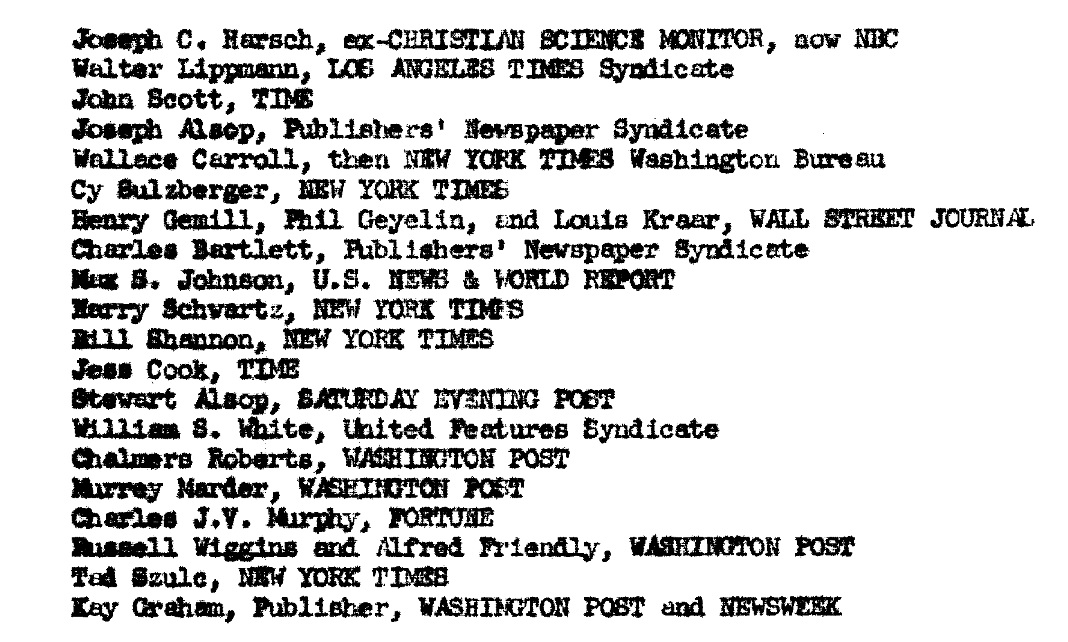
The United States Senate Select Committee to Study Governmental Operations with Respect to Intelligence Activities found in 1975 that the CIA submitted stories to the American press:
Wikipedia adds details:
After 1953, the network was overseen by Allen W. Dulles, director of the CIA. By this time, Operation Mockingbird had a major influence over 25 newspapers and wire agencies. The usual methodology was placing reports developed from intelligence provided by the CIA to witting or unwitting reporters. Those reports would then be repeated or cited by the preceding reporters which in turn would then be cited throughout the media wire services.
The Office of Policy Coordination (OPC) was funded by siphoning off funds intended for the Marshall Plan [i.e. the rebuilding of Europe by the U.S. after WWII]. Some of this money was used to bribe journalists and publishers.
In 2008, the New York Times
wrote:
During the early years of the cold war, [prominent writers and artists, from Arthur Schlesinger Jr. to Jackson Pollock] were supported, sometimes lavishly, always secretly, by the C.I.A. as part of its propaganda war against the Soviet Union. It was perhaps the most successful use of “soft power” in American history.
A CIA operative
told Washington Post owner Philip Graham … in a conversation about the willingness of journalists to peddle CIA propaganda and cover stories:
You could get a journalist cheaper than a good call girl, for a couple hundred dollars a month.
Famed Watergate reporter Carl Bernstein
wrote in 1977:
More than 400 American journalists … in the past twenty‑five years have secretly carried out assignments for the Central Intelligence Agency, according to documents on file at CIA headquarters.
***
In many instances, CIA documents show, journalists were engaged to perform tasks for the CIA with the consent of the managements of America’s leading news organizations.
***
Among the executives who lent their cooperation to the Agency were [the heads of CBS, Time, the New York Times, the Louisville Courier‑Journal, and Copley News Service. Other organizations which cooperated with the CIA include [ABC, NBC, AP, UPI, Reuters], Hearst Newspapers, Scripps‑Howard, Newsweek magazine, the Mutual Broadcasting System, the Miami Herald and the old Saturday Evening Post and New York Herald‑Tribune.
***
There is ample evidence that America’s leading publishers and news executives allowed themselves and their organizations to become handmaidens to the intelligence services. “Let’s not pick on some poor reporters, for God’s sake,” William Colby exclaimed at one point to the Church committee’s investigators. “Let’s go to the managements.
***
The CIA even ran a formal training program in the 1950s to teach its agents to be journalists. Intelligence officers were “taught to make noises like reporters,” explained a high CIA official, and were then placed in major news organizations with help from management.
***
Once a year during the 1950s and early 1960s, CBS correspondents joined the CIA hierarchy for private dinners and briefings.
***
Allen Dulles often interceded with his good friend, the late Henry Luce, founder of Time and Life magazines, who readily allowed certain members of his staff to work for the Agency and agreed to provide jobs and credentials for other CIA operatives who lacked journalistic experience.
***
In the 1950s and early 1960s, Time magazine’s foreign correspondents attended CIA “briefing” dinners similar to those the CIA held for CBS.
***
When Newsweek was purchased by the Washington Post Company, publisher Philip L. Graham was informed by Agency officials that the CIA occasionally used the magazine for cover purposes, according to CIA sources. “It was widely known that Phil Graham was somebody you could get help from,” said a former deputy director of the Agency. “Frank Wisner dealt with him.” Wisner, deputy director of the CIA from 1950 until shortly before his suicide in 1965, was the Agency’s premier orchestrator of “black” operations, including many in which journalists were involved. Wisner liked to boast of his “mighty Wurlitzer,” a wondrous propaganda instrument he built, and played, with help from the press.)
***
In November 1973, after [the CIA claimed to have ended the program], Colby told reporters and editors from the New York Times and the Washington Star that the Agency had “some three dozen” American newsmen “on the CIA payroll,” including five who worked for “general‑circulation news organizations.” Yet even while the Senate Intelligence Committee was holding its hearings in 1976, according to high‑level CIA sources, the CIA continued to maintain ties with seventy‑five to ninety journalists of every description—executives, reporters, stringers, photographers, columnists, bureau clerks and members of broadcast technical crews. More than half of these had been moved off CIA contracts and payrolls but they were still bound by other secret agreements with the Agency. According to an unpublished report by the House Select Committee on Intelligence, chaired by Representative Otis Pike, at least fifteen news organizations were still providing cover for CIA operatives as of 1976.
***
Those officials most knowledgeable about the subject say that a figure of 400 American journalists is on the low side ….
There were a lot of representations that if this stuff got out some of the biggest names in journalism would get smeared ….
A 4-part BBC documentary called the “Century of the Self” shows that an American – Freud’s nephew, Edward Bernays – created the modern field of manipulation of public perceptions, and the U.S. government has extensively used his techniques.
John Pilger is a highly-regarded journalist (the BBC’s world affairs editor John Simpson remarked, “A country that does not have a John Pilger in its journalism is a very feeble place indeed”). Pilger
said in 2007:
We now know that the BBC and other British media were used by the British secret intelligence service MI-6. In what they called Operation Mass Appeal, MI-6 agents planted stories about Saddam’s weapons of mass destruction, such as weapons hidden in his palaces and in secret underground bunkers. All of these stories were fake.
***
One of my favorite stories about the Cold War concerns a group of Russian journalists who were touring the United States. On the final day of their visit, they were asked by the host for their impressions. “I have to tell you,” said the spokesman, “that we were astonished to find after reading all the newspapers and watching TV day after day that all the opinions on all the vital issues are the same. To get that result in our country we send journalists to the gulag. We even tear out their fingernails. Here you don’t have to do any of that. What is the secret?”
Nick Davies
wrote in the Independent in 2008:
For the first time in human history, there is a concerted strategy to manipulate global perception. And the mass media are operating as its compliant assistants, failing both to resist it and to expose it.
The sheer ease with which this machinery has been able to do its work reflects a creeping structural weakness which now afflicts the production of our news. I’ve spent the last two years researching a book about falsehood, distortion and propaganda in the global media.
The “Zarqawi letter” which made it on to the front page of The New York Times in February 2004 was one of a sequence of highly suspect documents which were said to have been written either by or to Zarqawi and which were fed into news media.
This material is being generated, in part, by intelligence agencies who continue to work without effective oversight; and also by a new and essentially benign structure of “strategic communications” which was originally designed by doves in the Pentagon and Nato who wanted to use subtle and non-violent tactics to deal with Islamist terrorism but whose efforts are poorly regulated and badly supervised with the result that some of its practitioners are breaking loose and engaging in the black arts of propaganda.
***
The Pentagon has now designated “information operations” as its fifth “core competency” alongside land, sea, air and special forces. Since October 2006, every brigade, division and corps in the US military has had its own “psyop” element producing output for local media. This military activity is linked to the State Department’s campaign of “public diplomacy” which includes funding radio stations and news websites. In Britain, the Directorate of Targeting and Information Operations in the Ministry of Defence works with specialists from 15 UK psyops, based at the Defence Intelligence and Security School at Chicksands in Bedfordshire.
In the case of British intelligence, you can see this combination of reckless propaganda and failure of oversight at work in the case of Operation Mass Appeal. This was exposed by the former UN arms inspector Scott Ritter, who describes in his book, Iraq Confidential, how, in London in June 1998, he was introduced to two “black propaganda specialists” from MI6 who wanted him to give them material which they could spread through “editors and writers who work with us from time to time”.
The government is
still paying off reporters to spread disinformation. And the corporate media are acting like
virtual “escort services” for the moneyed elites, selling access – for a price – to powerful government officials, instead of actually investigating and reporting on what those officials are doing.
One of the ways that the U.S. government spreads propaganda is by making sure that it gets its version out first. For example, the head of the U.S. Information Agency’s television and film division – Alvin A. Snyder – wrote in his book Warriors of Disinformation: How Lies, Videotape, and the USIA Won the Cold War:
All governments, including our own, lie when it suits their purposes. The key is to lie first.
***
Another casualty, always war’s first, was the truth. The story of [the accidental Russian shootdown of a Korean airliner] will be remembered pretty much the way we told it in 1983, not the way it really happened.
In 2013, the American Congress
repealed the formal ban against the deployment of propaganda against U.S. citizens living on American soil. So there’s even
less to constrain propaganda than before.
One of the most common uses of propaganda is to sell unnecessary and counter-productive wars. Given that the American media is
always pro-war, mainstream publishers, producers, editors, and reporters are
willing participants.
It’s not just lying about Saddam’s non-existent weapons of mass destruction … the corporate media is
still selling lies to promote war.
Former Newsweek and Associated Press reporter Robert Parry notes that Ronald Reagan and the CIA unleashed a propaganda campaign in the 1980’s to sell the American public on supporting the Contra rebels, utilizing private players such as Rupert Murdoch to spread disinformation. Parry notes that many of the same people that led Reagan’s domestic propaganda effort in the 1980’s are in power today:
While the older generation that pioneered these domestic propaganda techniques has passed from the scene, many of their protégés are still around along with some of the same organizations. The National Endowment for Democracy, which was formed in 1983 at
the urging of CIA Director Casey and under the supervision of Walter Raymond’s NSC operation, is still run by the same neocon, Carl Gershman, and has an even bigger budget, now exceeding $100 million a year.
Gershman and his NED played important behind-the-scenes roles in instigating the Ukraine crisis by financing activists, journalists and other operatives who supported the coup against elected President Yanukovych. The NED-backed Freedom House also beat the propaganda drums. [See Consortiumnews.com’s “
A Shadow Foreign Policy.”]
Two other Reagan-era veterans, Elliott Abrams and Robert Kagan, have both provided important intellectual support for continuing U.S. interventionism around the world. Earlier this year, Kagan’s article for The New Republic, entitled “
Superpowers Don’t Get to Retire,” touched such a raw nerve with President Obama that he hosted Kagan at a White House lunch and crafted the presidential commencement speech at West Point to deflect some of Kagan’s criticism of Obama’s hesitancy to use military force.
***
Rupert Murdoch’s media empire is bigger than ever ….
Another key to American propaganda is the
constant repetition of propaganda. As Business Insider
reported in 2013:
From Lt. Col. Davis:
In context, Colonel Leap is implying we ought to change the law to enable Public Affairs officers to influence American public opinion when they deem it necessary to “protect a key friendly center of gravity, to wit US national will.”
The Smith-Mundt Modernization Act of 2012 appears to serve this purpose by allowing for the American public to be a target audience of U.S. government-funded information campaigns.
Davis also quotes Brigadier General Ralph O. Baker — the Pentagon officer responsible for the Department of Defense’s Joint Force Development — who defines Information Operations (IO) as activities undertaken to “shape the essential narrative of a conflict or situation and thus affect the attitudes and behaviors of the targeted audience.”
Brig. Gen. Baker goes on to equate descriptions of combat operations with the standard marketing strategy of repeating something until it is accepted:
For years, commercial advertisers have based their advertisement strategies on the premise that there is a positive correlation between the number of times a consumer is exposed to product advertisement and that consumer’s inclination to sample the new product. The very same principle applies to how we influence our target audiences when we conduct COIN.
And those “thousands of hours per week of government-funded radio and TV programs” appear to serve Baker’s strategy, which states: “Repetition is a key tenet of IO execution, and the failure to constantly drive home a consistent message dilutes the impact on the target audiences.”
Government Massively Manipulates the Web, Social Media and Other Forms of Communication
Of course, the Web and social media have become a huge media platform, and the Pentagon and other government agencies are
massively manipulating both.
Cross-Border Propaganda
Propaganda isn’t limited to our own borders …
Sometimes, the government plants disinformation in American media in order to mislead foreigners. For example, an official government summary of America’s overthrow of the democratically-elected president of Iran in the 1950′s
states, “In cooperation with the Department of State, CIA had several articles planted in major
American newspapers and magazines which, when reproduced in Iran, had the desired psychological effect in Iran and contributed to the war of nerves against Mossadeq” (page x).
Everyone Who Challenges the Status Quo Is Labeled As a Purveyor of “Fake News” … Or Worse
The First Amendment of the U.S. Constitution protects the freedom of the press from censorship by government.
Why? Because the Founding Father knew that governments (like the British monarchy) will always crack down on those who point out that the emperor has no clothes.
But the freedom of the press is under massive attack in America today …
When financially-savvy bloggers challenged the Federal Reserve’s policy, a Fed official
called all bloggers stupid and unqualified to comment.
- The government admits that journalists could be targeted with counter-terrorism laws (and here). For example, after Pulitzer Prize winning journalist Chris Hedges, journalist Naomi Wolf, Pentagon Papers whistleblower Daniel Ellsberg and others sued the government to enjoin the NDAA’s allowance of the indefinite detention of Americans – the judge asked the government attorneys 5 times whether journalists like Hedges could be indefinitely detained simply for interviewing and then writing about bad guys. The government refused to promise that journalists like Hedges won’t be thrown in a dungeon for the rest of their lives without any right to talk to a judge
- In an effort to protect Bank of America from the threatened Wikileaks expose of the bank’s wrongdoing, the Department of Justice told Bank of America to a hire a specific hardball-playing law firm to assemble a team to take down WikiLeaks (and see this)
Disclaimer: The contents of this article are of sole responsibility of the author(s). The Centre for Research on Globalization will not be responsible for any inaccurate or incorrect statement in this article.

 Thank you @stengel for discussing your experience in media & government, digital platforms, Trump administration & more at @shorensteinctr.,
  RT @npalmerrothman: The people who can change Washington are the people who understand how it works. @stengel @ShorensteinCtr https://t.co/C4NDVje1la,