American University will hold to tradition and host its 133rd commencement ceremony on Mother’s Day weekend. The ceremony will take place in AU’s Bender Arena and feature an impressive roster of commencement speakers who will offer advice and congratulations to roughly 3,500 graduates. AU’s 2017 commencement speakers demonstrate compassion, integrity, and unwavering commitment to public service. Individual school ceremonies will be held on May 13 and 14, followed by a ceremony for the Washington College of Law graduates on May 21.
The Honorable Patricia Harrison [JB - see], President and Chief Executive Officer of the Corporation for Public Broadcasting (CPB), will address the graduates of the School of Public Affairs at 9 a.m., Saturday, May 13. Honored for her commitment to diversity, Harrison established the first Diversity and Innovation Fund for public media — radio, television, online and mobile. Under her leadership, CPB launched American Graduate: Let's Make It Happen, a nationwide public media initiative to help communities across the country identify and implement solutions to the high school dropout crisis, and has been named to the Forbes list of “Women Changing the World in Media” for her efforts to empower women and girls globally. ...
Ms. Harrison has served as Assistant Secretary of State for Educational and Cultural Affairs and Acting Under Secretary for Public Diplomacy and Public Affairs, and she is the author of two books, A Seat At The Table: An Insider's Guide for America's New Women Leaders and America's New Women Entrepreneurs. The Honorable Patricia Harrison, an alumna of American University’s College of Arts and Sciences, will receive an honorary Doctor of Public Service degree. ...
Image from, under the title: "The Colorful Philippine Jeepney"
Excerpt:
MANILA, Philippines — Finance Secretary Carlos Dominguez III said that jeepneys plying Philippine streets and avenues should now be “relegated to the museum” as he signed an agreement that would help drivers and operators purchase new and more energy-friendly vehicles.
During the signing of the memorandum of agreement (MOU) on the program to replace the country’s entire fleet of public utility jeepneys (PUJs), Dominguez said that the “well-loved” mode of public transportation has already become an “inefficient dinosaur” that must be “relegated to the museum,” adding that it should now be replaced with “cleaner, healthier, safer and more fuel-efficient” means of public conveyance.
Dominguez admitted though that convincing PUJ drivers and operators to shift to a better mode of transportation would be “politically challenging.”
The Finance secretary said that to overcome possible opposition to the government’s modernization plan it would need to engage in better public diplomacy.
“There will be political resistance, no doubt, from those who do not wish change. We will have to conduct effective public diplomacy to raise the acceptance of this program. We must convince the jeepney drivers and operators that this is the way to go. They must understand the financing package will make the shift affordable,” Dominguez said. ...
A 20-member delegation of National Defence University (NDU) visited Pakistan Embassy in Paris today, where they received a briefing from Pakistan's Ambassador to France Moin ul Haque on Pakistan France bilateral relations.
Ambassador said that the Pakistan and France enjoy cordial and warm bilateral relations and closely work together on issues of global peace and security. The countries aim to further strengthen the relations through high level visits, parliamentary exchanges, private sector interaction, investments, education and cultural cooperation.
He said that steady increase in bilateral trade which registered an overall increase of 16% last year augurs well for the future. The recent successful visit of French business delegation would further contribute in consolidation of economic and commercial relations.
The Ambassador also briefed them about Embassy's public diplomacy initiative under the theme 'Celebrating Pakistan' to show case Pakistan's rich cultural heritage in France with a view to promote soft image of Pakistan.
During its weeklong study tour to Paris, the NDU delegation is scheduled to visit French Ministry of Defence and Ministry of Foreign Affairs. The Delegation will also interact with French Center for Advance [sic] Studies and Foundation for Strategic Research to receive briefings about French perspectives about domestic, regional and international political and security environment.
NDU is one of Pakistan's premier training institutions. It is a renowned center of excellence in academic and research pursuits providing policy inputs on national security at strategic level and acting as a national think tank.
Job Vacancy: Management Support Officer Economic Department
News item | 02-05-2017 | 10:59
Interested candidates can submit their application through a motivation letter and resume/CV, including the names and contact details for two references.
A. General Information
Position:
Management Support Officer EA
Embassy:
Jakarta, Indonesia
Salary Scale:
5
Working Hours:
35
B. Tasks
Main Tasks
Provides general administrative support to the Economic Department;
Handles correspondence for the Department;
Contributes to the organization of trade promotion and networking events, such as conferences, trade fairs and exhibitions;
Contributes to the preparations for Dutch official visits and for Dutch trade missions to Indonesia and supports the missions in-country;
Maintains contacts with ministries, government agencies, sector organizations, NGO’s and companies and keeps the contact databases up to date;
Provides administrative support for the commercial and development cooperation programs of the Economic Department.
Results to be achieved
Embassy staff members and Dutch companies satisfied with services delivered
Missions and trade promotion events organized successfully
Administrative tasks performed effectively and accurately
Financial administration accurate and up to date
Databases with company information up to date
Working Experience and Knowledge
Secretarial Academy or equivalent education
Knowledge and experience in the field of office management
Fluency in Indonesian and good command of the English language, both written and orally. Knowledge of Dutch is an advantage.
Good communication skills
Excellent computer skills
Competencies required
Organizational skills
Client focused, service oriented
Flexible team player
Writing skills
Result oriented
Integrity
C. Working Environment
The management support officer will be employed within the Economic Department, which is part of the Embassy of the Kingdom of the Netherlands in Jakarta. The Economic Department consists of four expatriate staff and eight locally recruited employees. The officer will report to the Head of the Economic Department or his Deputy. He or she will collaborate regularly with staff of the other departments for political, public diplomacy, cultural, consular and general affairs.
The embassy is putting more and more emphasis on individual responsibility and pro-active behavior. This is part of a transformation process that also includes the introduction of open workspaces and broadening of the group of tenants on the embassy’s premises.
The Economic Department is responsible for economic diplomacy, particularly promoting and facilitating bilateral trade and investment, as well as development cooperation in the fields of water, maritime, food security and improvement of the investment climate. The nature of the assignment occasionally requires staff to work outside of regular office hours.
Description of employee
An efficient management support officer who maintains high standards of accuracy, quality and timeliness. Enjoys providing the best possible support to the staff of the Economic Department. Is able to work independently and as part of a team. Has an interest in economic cooperation and is flexible as to the exact assignments and fields covered.
Information
For information regarding this vacancy please contact Siebe Schuur of Tess van der Zee, respectively Head and Deputy Head of the Economic Department; jak-ea@minbuza.nl.
12 month, full time contract position with the potential for extension
Based in Vientiane
The Program
The goal of BEQUAL is to ensure all girls and boys, especially those experiencing disadvantage, complete a quality basic education to achieve literacy, numeracy and other life skills. The program will address education policy, planning and coordination, increased child participation in and access to basic education, teacher education and improved school infrastructure.
Coffey through BEQUAL is currently seeking applications from Lao nationals for the position of National Primary Curriculum Support Officer.
The Position
The Communications Coordinator will assist in the development and implementation of media, communications and promotional activities in support of BEQUAL goals and objectives and report directly to the Communication Specialist.
The Communications Coordinator supports the development and implementation of all public diplomacy, promotional and communications materials and maintains close working relationships with DFAT Vientiane, Ministry of Education officers, BEQUAL partners and media stakeholders.
This role plays an important part in the implementation of BEQUAL’s Communication Strategy.
The Person
The ideal candidate will have a Degree in Communication, Public Relations, Media or a related field and will have considerable experience in delivering high quality communication activities and initiatives. Demonstrated experience in writing, editing and proof reading communication documents for publication combined with the experience in working with the media and government agencies will be required for success. Strong computer skills with Indesign, Publisher, website applications as well as exceptional interpersonal skills, the ability to network and work collaboratively with colleagues are all essential.
This position is open to Lao nationals only.
HOW TO APPLY:
How to Apply
For a detailed position description and to apply for these positions please visit www.coffey.com/careers and search for the job reference number 495298
Students from a Confucius Institute in the US visiting the Confucius Temple in Qufu, China, April 17, 2013
Since their beginning in 2005, Confucius Institutes have been set up to teach Chinese language classes in more than one hundred American colleges and universities, including large and substantial institutions like Rutgers University, the State Universities of New York at Binghamton and Albany, Purdue, Emory, Texas A & M, Stanford, and others. In addition, there are now about five hundred sister programs, known as “Confucius Classrooms,” teaching Chinese in primary and secondary schools from Texas to Massachusetts.
But while the rapid spread of these institutes has been impressive, in recent years their unusual reach in the American higher education system has become increasingly controversial: Confucius Institutes are an official agency of the Chinese government, which provides a major share, sometimes virtually all, of the funds needed to run them. Though they are housed in US institutions, their curriculum is largely shaped by Chinese guidelines. Moreover, they have often been set up in secretive agreements with host institutions, which has caused Western scholars to question whether their universities are ceding undue control to a foreign government—in this instance, a foreign government well known for aggressively propagandizing its official views, censoring dissenting opinions, and imprisoning those who express them.
Responding to such complaints, a number of schools, including the University of Chicago, Penn State, and McMaster University in Canada, have closed their CIs down. The University of Chicago, for example, did so in 2014 after some one hundred faculty members signed a petition saying that the CIs were incompatible with the “values” of the University. “This is really an anomalous sort of arrangement,” Bruce Lincoln, one of the organizers of the petition, toldInside Higher Ed, “where an entity outside the university and a powerful entity and an entity that has strong interest in what’s taught is in effect seriously influencing who’s teaching and what’s taught under our name and inside our curriculum.”
Now the National Association of Scholars, a conservative group whose members are mostly American university professors, has issued the most complete report on the CIs to date, a detailed 177-page document called “Outsourced to China: Confucius Institutes and Soft Power in American Higher Education.” The NAS study, which was conducted by Rachelle Peterson, the group’s director of research projects, comes to conclusions similar to those of a study by the American Association of University Professors three years ago, and it makes similar recommendations: that the CIs either be closed or reformed. (There are about ten CIs in Canada, where the Association of University Teachers three years ago likewise recommended that they be reformed or closed.)
Among the NAS report’s findings are that CI teachers face “pressures to avoid sensitive topics” like Tibet, Taiwan, or China’s human rights record; that the teachers, recruited and trained in China, adhere to Chinese restrictions on speech; and that there is an absence of “transparency” in the CIs’ operations. Peterson visited twelve CIs in New York and New Jersey and almost all of them refused to make their contracts with the Chinese government public; administrators at some of them refused even to talk to Ms. Peterson or to allow her to visit classrooms. The NAS report also echoes concerns expressed by earlier critics of the CIs that the Chinese funding they attract has given universities a strong financial incentive to host them, to the point that some universities may find it hard to close their CIs “without jeopardizing other financial relationships.” Instead, there is an interest in presenting “China in a positive light” and in focusing “on anodyne aspects of Chinese culture,” glossing over “Chinese political history and human rights abuses.”
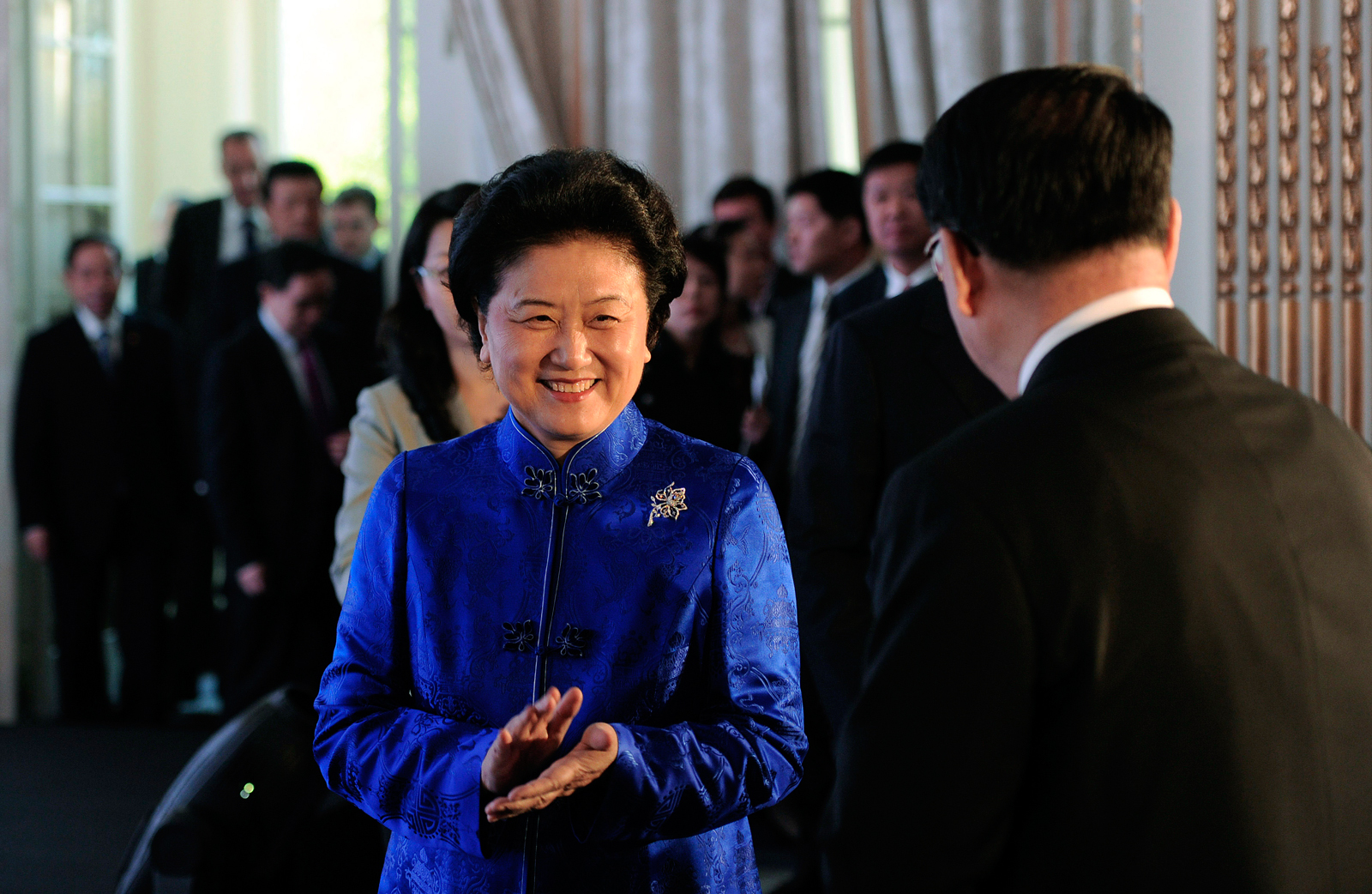
The CI program is supervised and controlled by the Chinese government. The supervisory body is the Office of Chinese Language Council International—the Hanban for short—which is a department of the Chinese Ministry of Education (although it is ultimately supervised by the Communist Party’s Central Propaganda Department, whose former head, Li Changchun, has been quoted in newspaper articles calling the CIs “part of China’s foreign propaganda strategy”). The senior official in charge, Liu Yandong, is a member of the Politburo of the Chinese Communist Party’s Central Committee. The Hanban provides subsidies—generally around $100,000 each year for the five-year duration of a contract—to participating institutions. It screens the teachers, all of them Chinese nationals, trains them, pays their salaries and airfares, dispatches them to the institution in question, and in most cases designs the curriculum. It also sends a Confucius Institute director who shares responsibility for running each program with a local co-director.
Yet it is hard to identify the specific threat the institutes pose. The NAS report does not contain what the organization’s director, Peter Wood, calls any “smoking guns” showing some egregious violation of academic principles, or even much in the way of widespread opposition from faculty or students. Indeed, the report contains testimonials from American participants in the program who deny they have felt any pressure from China to adhere to the country’s line, or any threats of losing their contracts and subsidies if they don’t.
“My sense is that our CI is not really doing anything nefarious,” David Stahl, a professor of Japanese literature and a CI board member at SUNY Binghamton, told Peterson. “I think, actually, given the terrible state of state funding for SUNY, it’s benefited us greatly.” Stephen Dunnet, an administrator at the University at Buffalo, told her, “It’s shameful that the only way we can offer Chinese in the Buffalo school district—which is almost bankrupt—is that we have to ask the Chinese… There is no way for them to learn Chinese if not for this program.”
So what, then, is the terrible danger? What worries many critics of the CIs is not that they will somehow be able to establish pro-China propaganda departments inside the American academy, but something more subtle—that close relations with a Chinese state agency and dependence on Chinese financial support will give China, not exactly a disinterested party, a strong say in how the country is presented to American elementary schoolchildren and college undergraduates alike. Chinese officials have extolled the CIs as an admirable and effective way of extending what they refer to as China’s soft power, and this is what makes some critics nervous. Will programs on China have the free, critical inquiry that American academic programs are supposed to have? Given China’s concerted efforts to control the discourse on sensitive topics like Tibet, Taiwan, and human rights, it seems unlikely that they could be discussed openly within the precincts of the CIs.
Paul Hackett/Reuters
Liu Yandong and Li Changchun at the London Book Fair, April 15, 2012
In a 2014 book, Confucius Institutes: Academic Malware, the University of Chicago anthropologist Marshall Sahlins expressed many of these points, arguing that self-censorship is virtually inevitable; otherwise the American partner institution would jeopardize China’s financial support. Sahlins argues that if prominent institutions like Chicago itself give credibility to the CIs, smaller places, especially those without existing, independent China programs, will be encouraged to set them up also, and as they become an accepted part of the academic scene, China will gain considerable influence over how it is presented in American classrooms. There are precedents for this concern: China has successfully pressured Hollywood to make changes in movies so that they can be shown in the Chinese market, has gotten Internet companies to turn over information about their users to the security police, and has used its economic power to dissuade countries from criticizing its human rights record.
Perry Link, professor emeritus of Chinese literature at Princeton, commented on the current and likely future effects of the “outsourcing,” as the NAS report puts it, of Chinese language teaching to China itself: “I would say mainly two things: 1) It induces self-censorship in CI recipients, which is very effective even in the absence of ‘smoking guns’; and 2) It projects a partial view of China, which incurs a double cost: a) taboo topics are not seen, and b) non-taboo topics would not look so innocuous if they could be seen in full context.”
One of the disturbing aspects of the Confucius Institutes is the secrecy in which their relations to host institutions are often kept. The authors of the NAS report were able, mostly by filing Freedom of Information Requests, to obtain the contracts signed between some of the American schools and the Hanban, and these contracts contain some strange clauses. One such clause, for example, prohibits “any activity conducted under the name of the Confucius Institute without permission or authorization from the Confucius Institute headquarters.” Another indicates a Chinese expectation that the CIs will observe Chinese law. What this means exactly is hard to know, since Chinese law does not extend to American universities, but it certainly sounds as though the American partners would be unable to have a program on, say, Tibet, unless it was prepared to denounce the Dalai Lama. The NAS report cites an incident in 2009 wherein North Carolina State University, which has a CI, rescinded an invitation to the Dalai Lama to speak on campus.
Peterson notes what she calls the “veil of secrecy” that seems to surround at least some of the CIs she visited in New York and New Jersey, which is the reason the NAS had to file FOIA requests to get the contracts signed between the Hanban and some of those institutions. Peterson was, for example, able to make an appointment to meet the CI director at SUNY Binghamtonthis person canceled the appointment a couple of days later, citing too many other responsibilities, then told Peterson that no member of his staff would be able to meet her and that she would be barred from sitting in on a class. A similar series of events took place at SUNY Albany, she says.
At Alfred University, a small private school that has had a CI since 2008, Peterson was sitting in on a class, having, she says, gotten permission from the teacher to do so, when the provost, Rick Stephens, appeared and ordered her to leave both the classroom and the campus right away. (A spokesperson at Alfred, Susan C. Goetschius, said in an email that Peterson “did not follow appropriate protocols as a non-student and/or journalist attending a class. She was asked to leave and she did so.”)
Peterson was cordially received at other campuses. Still, one wonders about this atmosphere of secretiveness at some schools. Do the administrators or the program worry that disclosing their Chinese connections and their need for Chinese funding will give material to critics of the program? Are the Chinese directors appointed by the Hanban, even those at public universities, fearful that they will get questions on human rights in China or Tibet or on how they deal with the subject of the 1989 crackdown?
Then there is the matter of Chinese teachers, selected and trained in China. A recent documentary film on the Confucius Institutes in Canada, called In the Name of Confucius, tells the story of Sonia Zhao, who was sent by the Hanban in 2011 to teach in the CI at McMaster University. When she went to the Hanban in Beijing to sign her contract, Zhao noticed a provision banning practitioners of Falun Gong, the sect that has been ferociously repressed in China. Zhao signed anyway, fearing that not to do so would identify her as the Falun Gong practitioner that she in fact was. She went to Toronto, and after some time living in terror that she would be found out by the Chinese director there, she left the program and got political asylum. McMaster terminated its CI arrangement in 2013.
Zhao’s case might be an unusual one, but if it is true that Falun Gong members are barred from membership, that would be religious discrimination and would appear to violate both American and Canadian law. Reporting on the Zhao case, the Toronto Globe and Mail cited a passage in the Hanban contracts according to which teachers are “not allowed to join illegal organizations such as Falun Gong.” This wording used to be posted on the Hanban’s English-language website, but it was removed after the Zhao case. Zhao says in the Canadian documentary that during their training in China, teachers are instructed in ways to avoid student questions on what are effectively banned topics, like Tibet or Falun Gong itself. “Don’t talk about that,” she says she was told. “If the student persists, you just try to change the topic or say something the Chinese Communist Party would prefer.”
The expansion of China’s presence in schools in the US and other countries is taking place at the same time that China itself is intensifying its crackdown on dissent, tightening its censorship of the internet, and publishing prohibitions on what it calls “false ideological trends,” which include promoting that the propaganda machinery calls “Western values.” Recently, the journalist Hannah Beech, writing in The New Yorker, cited a statement by Chen Baosheng, China’s minister of education, who warned that schools in China “are the main target for infiltration by hostile forces,” and he vowed that he would “never let textbooks promoting Western values appear in our classes.”
The Confucius Institutes, it will be remembered, are run by an agency under the very Ministry of Education that Chen heads. The Hanban website currently carries reports on the Confucius Institute’s eleventh annual congress, which was held in Yunnan Province last December with 2,200 delegates participating from 140 countries. Several senior Chinese officials, including Politburo member Liu Yandong, gave speeches. On the program was a presentation of China’s “One Belt One Road” initiative, the country’s plan to build a network of relationships across Eurasia. Chen was the official host of the event.
Again, there’s no “smoking gun” here, but there is a paradox. Chen has had remarkable success in building a presence for China in American (and many other countries’) schools even as he has publicly expressed his determination never to allow Western influence—or, as he called it, “infiltration”—to flow in the other direction.
A Princeton PhD, was a U.S. diplomat for over 20 years, mostly in Central/Eastern Europe, and was promoted to the Senior Foreign Service in 1997. After leaving the State Department in 2003 to express strong reservations about the planned U.S. invasion of Iraq, he shared ideas with Georgetown University students on the tension between propaganda and public diplomacy. He has given talks on "E Pluribus Unum? What Keeps the United States United" to participants in the "Open World" program. Among Brown’s many articles is his latest piece, “Janus-Faced Public Diplomacy: Creel and Lippmann During the Great War,” now online. He is the compiler (with S. Grant) of The Russian Empire and the USSR: A Guide to Manuscripts and Archival Materials in the United States (also online). In the past century, he served as an editor/translator of a joint U.S.-Soviet publication of archival materials, The United States and Russia: The Beginning of Relations,1765-1815. His approach to "scholarly" aspirations is poetically summarized by Goethe: "Gray, my friend, is every theory, but green is the tree of life."