Wednesday, June 29, 2016

Al Jazeera Conducts Interview With The Obama Administration's Ben Rhodes At Global Entrepreneurship Summit


prnewswire.com

image from

Rhodes Discussed President Obama's Administration's Decision not to Take Military Action in Syria even as War Continues and Concerns about Iran's Influence

Interview Will Air on Al Jazeera's "Min Washington" with Abderrahim Foukara on Tuesday, July 5th at 15:05 GMT, with Excerpts Currently Airing on Other Al Jazeera News Programs


Al Jazeera's Washington, D.C. bureau chief, Abderrahim Foukara, conducted an interview with Ben Rhodes, Assistant to the President and Deputy National Security Advisor for Strategic Communications and Speechwriting in President Obama's Administration, during the Global Entrepreneurship Summit ("GES") in Silicon Valley, which concluded on Friday. Al Jazeera was the international broadcasting partner to GES. Highlights of the interview, focused on the war in Syria, appear below.

The 14-minute interview will air in full on the Al Jazeera Arabic program "Min Washington" on Tuesday, July 5th at 15:05 GMT and will be re-broadcast on Wednesday July 6th at 07:05 GMT and Thursday July 7th at 22:05 GMT. Additionally, excerpts are currently running on Al Jazeera's news programs in both English and Arabic, and included on AJ+, the Network's widely viewed online news platform. It will also air in full on Al Jazeera English.

On President Obama becoming increasingly resolved, after five years of war in Syria, that he will not take military action, Rhodes said:

"If we felt like there was a military option that could succeed, if we felt like there was a force, a military option that had a strong domestic and international legal basis that had a clear plan for how we were going to see it through, that could address the underlying political questions that have fueled the Syrian civil war, we would be open to that. The President has used military force in many different countries including North Africa and Libya. The fact of the matter is, it's not simply because we are concerned about the enormous resource allocations that go with that type of military action. It's because the President has not seen a plan that he believes successfully can bring an end to the conflict, and we believe ultimately that's going to need a political framework."

On calls from the region and even US diplomats who want the Obama Administration to take a more robust position regarding President Assad, Rhodes said:

"I think when you look at the specific question of how do we deal with Bashar Al Assad, it's been our long standing position that he should leave power, that any political transition has to include him departing power, that we have supported groups inside of Syria who oppose Bashar Al Assad. At the same time, we very much welcome the views expressed in that dissent cable. We have had open debates as a government for many years. The problem that we see is, we don't believe that there is a US imposed military solution that can resolve the situation in Syria."

On relations with Iran getting closer and criticism that the Obama Administration is allowing Iran to continue its influence in Syria, Rhodes commented:

"With respect to Iran, we have been very clear here that we reached an agreement that we saw as very positive but focused on one issue; the nuclear issue, and that is not a symbol of a broader rapprochement. We are actually acting in opposition to Iranian policies in many parts of the region. We do believe that the nuclear deal was worth it. And I think that even if you assign the worst intentions to the Iranians, you would want them to not have a nuclear weapon, because if you take everything that they are doing in the region today that is troubling and you put a nuclear umbrella essentially over that, that would be much more destabilizing and dangerous even in the very difficult circumstances we have today."

Highlights of Al Jazeera's Coverage at the GES

Al Jazeera was the international broadcasting partner to GES, which included, among other global future-oriented events, President Obama hosting a roundtable for entrepreneurs from around the world, including Mark Zuckerberg of Facebook. Al Jazeera covered these events, as part of its in-depth reporting over the course of this critical three-day, knowledge-sharing event.

Included in this reporting as well, Foukara interviewed U.S. Secretary of State John Kerry and AJ+ hosted its first-ever Facebook Live interview with Under Secretary for Public Diplomacy and Public Affairs Richard Stengel.

The interview with Secretary Kerry will air in full on "Min Washington" on Tuesday July 5th at 11:05 PM ET and will be re-broadcast on Wednesday and Thursday of that week. Additionally, excerpts are currently running on Al Jazeera's news programs in both English and Arabic, and being included on AJ+. It will also air in full on Al Jazeera English.

Understanding American Public Diplomacy and the Role of the Private Citizen: A Case Study of America’s Unofficial Ambassadors (AUA)


repository.asu.edu


Image (not from entry) from, with caption: The Ambassador, a bowler-hat-shaped, Indian-made automobile born in 1957 to a newly independent nation, was once the height of style and status.

AbstractThis study explores the effectiveness of citizen diplomacy and more specifically America’s Unofficial Ambassadors as an international non-governmental organization focused on engaging more Americans in citizen diplomacy throughout the Muslim world. America’s Unofficial Ambassadors is part of a larger trend to include citizen involvement in diplomacy through cooperation with international non-governmental organizations (NGOs). A questionnaire was created with 16 questions (see Appendix A&B) focused on measuring America’s Unofficial Ambassadors effectiveness. All participants (N=33) were alumni of one of America’s Unofficial Ambassadors’ signature programs. They were invited via email to complete the questionnaire. Most participants were ... (more)
Created Date2016-05
ContributorGriffin, Brieanna Jontae (Author) / Gallab, Abdullahi (Thesis Director) / Ripley, Charles (Committee member) / Historical, Philosophical & Religious Studies, Sch () / School of Politics and Global Studies () / School of International Letters and Cultures () /School of Human Evolution & Social Change () / Department of English () / Barrett, The Honors College ()
Subjectcitizen diplomacy / Muslim world / America's Unofficial Ambassadors (AUA)
SeriesAcademic Year 2015-2016
TypeText
Extent71 pages
LanguageEnglish
RightsAll Rights Reserved
Collaborating InstitutionsBarrett, The Honors College
Additional FormatsMODS / OAI Dublin Core / RIS

Israel's internet Iron Dome: How high-tech algorithms promote Israel and 'muffle' pro-Palestine voices online


Shira Rubin, ibtimes.co.uk [article contains additional images]

image from article

Dor Elidan, a polite 16-year-old sporting a short Mohawk, admits that he doesn't know enough about politics to form an opinion on the Israeli-Palestinian conflict – but that he felt "privileged" to write an algorithm that is now being used by the Israeli government to hit back at anti-Semitism and enemies of the state online.
The code is part of a platform that boosts positive social media posts, photos, news reports and opinion articles that promote Israel – whether that be its booming tech scene or its beautiful beaches – and plays down posts featuring Israeli checkpoints or Palestinian prisoners.
More foreign news from IBTimesUK


As part of the algorithm, Elidan developed the hashtag #Israelretweetedme from his bedroom in the Jerusalem neighbourhood that also houses Israel's prime minister, Benjamin Netanyahu. It allows Israel's foreign ministry to retweet favourable posts and photos via the accounts of 153 Israeli diplomats and policymakers, reaching more than one million people.
Elad Ratson, the head of research and development for the digital diplomacy department at the foreign ministry, cannot explain exactly the second part of the platform, which works to "muffle" pro-Palestinian voices in social media, but said that it is a continuation and an upgrade from efforts undertaken during the Israel-Gaza war in 2014, when students set up a "situation room" at the Interdisciplinary Center in Herzliya.
Amidst Israel's bloody 50-day operation in Gaza – during which 73 Israelis and more than 2,100 Palestinians died – as many as 600 student volunteers gathered to tweet under the hashtag #IsraelUnderFire, as a response to #GazaUnderAttack, a campaign that featured gruesome photos of bloodshed and destruction in the Gaza Strip.
The updated foreign ministry programme is a smaller affair, relying on a small group of individuals who over the past eight months of a "knife intifada – fuelled mostly by young, politically unaffiliated Palestinians who used Facebook to document and encourage attacks against Israeli soldiers and civilians – have worked to restrict the viral spread of pro-Palestinian Facebook posts which incite to violence", said Ratson.


While Ratson and Elidan boast of the success of the programme, neither are able to say to what extent the messages put on social media work to engage foreign users, or simply "preach to the choir".
In August, 2014, the social media search engine Topsy found the Gaza hashtag was used more than four million times, whereas the Israel one had been used 170,000 times – the most dramatic online example of Israel's "asymmetric numbers game", said Ratson, in which the number of dead Palestinians has always exceeded Israeli casualties, and has therefore led the stories online and in the press, he argued.
Israeli politicians have long argued that their aims are to win the wars rather than international sympathy, but Ratson said that it has been paying more attention to the dangers of viral campaigns after August 2015, when an attempt to recreate a "Tel Aviv beach" on the Parisian Seine sparked outrage in social media and drew press attention, but only attracted a few dozen demonstrators on the ground.
"It was mayhem, but it was enabled by 40,000 automated posts" that were the result of codes rather than actual people, said Ratson. "The entire pro-Palestine system aiming to distribute lies about Israel is one that has [...] hotspots in such countries like France, [fuelled by] second and third generation tech geeks [and] the vast world of social media."
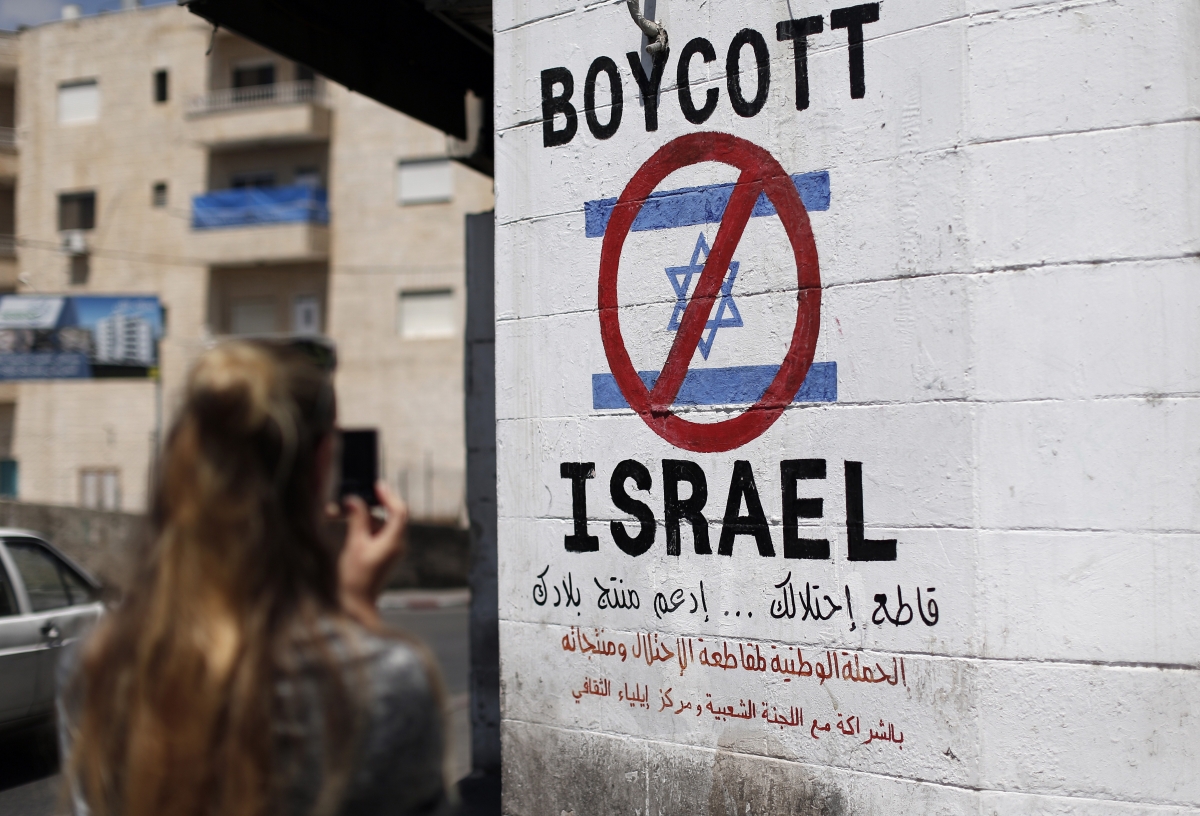
BDS sign in the West Bank

A sign painted on a wall in the West Bank in June 2015, calling to boycott Israeli products coming from Jewish settlementsGetty

To meet the growing demand for an online presence, both during times of war and times of peace, Ratson is in collaboration with the Rothschild Fund and other private pro-Israeli organizations, to scour high schools, universities, and private tech companies in both Israel and abroad to participate in an upcoming collaboration project slated to launch in the autumn.
But as the foreign ministry focuses on magnifying its digital prowess, it is markedly not restrategising its message to speak to a young, internationally-minded generation who have called for a more nuanced debate on the Israeli-Palestinian conflict.
A May report by the state comptroller found the foreign ministry to have no overall strategy, insufficient funds and general failures in the fight against the Boycott, Divestment and Sanctions (BDS) campaigns. Its isolation is also apparent in the United Nations Human Rights Council, which has condemned its alleged human rights abuses more than all the other nations of the world combined.
We're fighting against movements that are a real threat to Israel.
Its shortcoming may be explained by the fact that the foreign ministry is led by Netanyahu instead of a full-time minister, who has done little to rein in public diplomacy catastrophes like that initiated by Deputy Foreign Minister Tzipi Hotovely, who earlier this year defied protocol and banned all Swedish officials after its foreign minister demanded an investigation into Israel's extrajudicial killings of assailants during the "knife intifada".
Danielle Israel, a 27-year-old graduate of the Interdisciplinary Center in Herzliya and current director of the university's public diplomacy programme, said that as the role of social media only continues to expand, the impact of government attempts is proving less "relevant" than those undertaken by civilians.
In the coming weeks, Israel and its colleagues will open the university's first peace-time "situation room," manned by 20 students and funded by private stipends, and which it hopes will be followed by similar initiatives in Los Angeles and throughout the rest of the world.
"Everyone today is on social media, so there's not an option not to do this," she said. "It's not political. We're fighting against movements that are a real threat to Israel."

Shira Rubin is a freelance journalist based in Jerusalem. Follow her at @shira_rubin

News of Terrorism and the Israeli-Palestinian Conflict


terrorism-info.org.il

Image from, with caption: Palestinian youths riot on the Temple Mount.
Excerpt:
Mahmoud Abbas Gives a Speech in Brussels Claiming Israel Poisons Palestinian Water Sources ...
[7]To minimize public diplomacy damage, the Palestinians deliberately deleted the remarks about poisoning water sources from the text of Mahmoud Abbas' speech (issued by the Palestinian news agency controlled by Mahmoud Abbas). An audio version of the speech was deliberately not posted to Mahmoud Abbas' official Facebook page, however the full version of the speech was posted to YouTube.

The Nation UNSC vote is not a referendum on Thailand's world standing


Pornpimol Kanchanalak, nationmultimedia.com

Image fom article, with caption: The 193 members of the United Nations General Assembly at the headquarters in New York on Tuesday elected Sweden, Bolivia, Ethiopia and Kazakhstan to UNSC.

After 7 wasted years, current government cannot be blamed for failure to win a seat

Excerpt:
In the next few days, the medias [sic] here in Thailand is likely to be awash with self-anointed international sages swinging at the current Thai government for having lost the bid for a non-permanent seat on the United Nations Security Council. ...
The current Thai government and the Foreign Ministry knew full well the high hurdles in the UN bid to compensate for lost time and opportunities, but it had the sportsman's spirit not to quit the race in the middle. With a much smaller budget, compared to that of the oil-rich Kazakhstan to spend on the campaign, the Thai Foreign Ministry attempted to do a double duty with the budget; it tried to carry out public diplomacy at every campaign stop. The strategy and the face-to-face contacts have improved Thailand's relations with many nations around the world. ...
Regarding the issue of human rights, those who care to check will find out that the issue has little or no relevance in the consideration for the Security Council seat. And on this issue, Thailand is not the worse of the two countries.
Lastly, contrary to the criticism that Thailand was shunned by Western countries due to the military government, countries such as Germany, the Netherlands, Italy and Australia, expressed their support for Thailand without any misgivings about the country's military leadership.
It is said that success has a thousand fathers, and failure has none. Like in any race, there is winner and loser, but Thailand can take pride in having played fair and by the rules in this campaign. The most important aspect of a race is to take part.
And taking part was what Thailand did.

Quotable: Michael Lumpkin on fighting terrorism online


Tuesday, June 28th 2016

Lumpkin image from

"The Obama administration is ramping up its efforts to fight terrorism online as extremist Islamic groups seek to motivate homegrown attackers,” reported Kristina Wong in a June 25, 2016, article, “How the US is working to defeat ISIS online,” in The Hill.  Wong interviewed Michael Lumpkin, Special Envoy and Coordinator of the Global Engagement Center (GEC) at the Department of State.  Some key paragraphs:

  • . . . the goal is to get the infrastructure in place to effectively counter terrorists' messaging beyond the Obama administration.  

  • . . . the GEC is an interagency body that pulls from all across government, including the intelligence community, versus just the State Department.  "We bring all the best and the brightest from the interagency coming together in a single place," he said.  

  • The president has also given Lumpkin hiring authority that allows him to hire directly from outside the government -- "people who know the technology better than we may in social media," he said.  

  • The office is also growing from 68 people earlier this year to about 150 now.  

  • Its budget has grown from $5.6 million in 2015, to more than $15 million this year. The administration has requested $21.5 million for 2017.  

  • The amount, which comes out of the State Department's budget, equals less than two days worth of military operations against the Islamic State in Iraq and Syria, at approximately $11.7 million a day. 

  • That's despite agreement across government that stopping terrorist propaganda online is as important as operations on the battlefield.  

  • "ISIS’s online dominance is just as critical to the organization as the large amounts of territory it controls in Iraq and Syria," said House Foreign Affairs Committee Chairman Ed Royce (R-Calif.) at a hearing on ISIS's "virtual caliphate" on Thursday.  

  • Another major difference from the previous effort is how the U.S. government is going about countering the message. 

  • Whereas the previous effort distributed U.S. government-branded messaging, Lumpkin says the GEC is applying a lesson honed by special operators during more than 15 years of war against terrorists around the world: 

  • "We recognize that it takes a network to defeat a network, so we're building a network of partners because we believe we have a very good message, we're not always just the most credible entity to convey that message," he said. 

  • "So we have partners that have a tremendous amount of credibility that we're working with to make sure they have the tools and capabilities to get out the word that Daesh is indeed a vicious awful organization that is rife with hypocrisy and everything else," he said, using a derogatory Arabic term for ISIS.  

  • So far, highlighting that hypocrisy is what's been shown to be most effective, particularly using defectors, Lumpkin said.  

  • "There's two ways to influence people, one is through, you know, logic, and then there's emotion," he said. "I think most of our efforts have been focused on having defectors tell their story."  

  • "What we're trying to do is build an innovative, agile organization, and while we're making significant inroads, it is just difficult based on the security constraints of IT networks and things of that nature," he said.  

  • Rep. Brad Sherman (D-Calif.) recently noted during the House Foreign Affairs Committee hearing that the State Department currently needs 14 levels of review before sending out a Tweet.  

  • Those who receive State Department funding also have to meet a bar, albeit a lower one, of six levels of review, he added. By contrast, he said, "If you're a volunteer, you do a tweet." 

Quotable: Peter Neumann on counter-narratives and the need for scale


publicdiplomacycouncil.org

Tuesday, June 28th 2016


image (not from entry) from


“ISIL has been more successful and effective in exploiting the internet than any group I have seen in 17 years of researching terrorism,” said Peter Neumann in his testimony before the June 23, 2016 hearing of the House Foreign Affairs Committee on “Countering the Virtual Caliphate.”  Neumann is Director of the International Centre for the Study of Radicalisation at King’s College London.  “The sophistication of some its media products, the range of platforms it uses, the way it segments according to audiences, and how it has succeeded – at times – in dominating the conversation, all this is unprecedented,” he added.  Here are more comments:

The online ecosystem of ISIL goes beyond the group itself, and it includes more than just the videos that everyone is always talking about. What gives ISIL so much punch online is also for example individual fighters, who facilitate one on one conversations.

  • It’s also what we call the cheerleaders and fanboys and wannabes -- people who aren’t actually members of ISIL, who aren’t actually in Syria, but are, essentially, freelance supporters, often based in the West. They are the ones who are giving the group its online oomph.

  • There isn’t one counter-narrative, and there isn’t one counter-narrator. Just like ISIL is segmenting its message according to audiences, we need to recognize that people are becoming attracted to ISIL for different reasons, have different interests, and are at different points along the path of radicalization.

  • What’s needed is scale. Scale, in my view, is more important than message. Even if we found the perfect message, the perfect messenger, and even if we managed to produce the perfect video, it would still be a drop in the ocean.  There still wouldn’t be oomph.  This is the internet. People are exposed to thousands of things every day.

  • Government alone will never be able to create the volume that’s needed; it’s not a credible messenger in this space; and worst of all government is by definition risk averse, which is the opposite of what you have to be online.

  • We need more data. It’s almost an embarrassment. It’s an embarrassment for everyone who works and is interested in this area. But we really don’t know what works. The initiatives that have happened have been so small scale and few in number, they haven’t generated enough data to make meaningful assertions. This must be a priority for industry, for government, and for NGOs running programs.