Thursday, May 30, 2019

[National Security Decision Directive-77 to promote public diplomacy]


National Security Decision Directive 77
From Wikipedia, the free encyclopedia
Jump to navigationJump to search
National Security Decision Directive 77
Directive showing signature of President Ronald Reagan
NSDD77
AuthorUnited States National Security Council
CountryUnited States
LanguageEnglish
PublishedJanuary 14, 1983 Federal government of the United States
Media typePrint
Pages3
National Security Decision Directive 77(NSDD-77; titled Management of Public Diplomacy Relative to National Security), was a U.S. National Security Directive signed on January 14, 1983 by President Ronald Reagan. The directive established a Special Planning Group (SPG) under the National Security Council (NSC) whose purpose was to strengthen, organize, plan, and coordinate public diplomacy of the United States relative to national security.[1]This NSDD positioned the White House and the National Security Staff at the helm of public diplomacy coordination across government agencies. NSDD-77 lay the groundwork for the Reagan administration's aggressive public diplomacy strategy and included guidance for inter-agency working groups to execute wide ranging tactics for information dissemination both domestically and internationally.
A National Security Decision Directive (NSDD) is a kind of Presidential Directive in which a President gives instructions to senior advisors and departments concerning matters of national security.[2]

Background[edit]

Public diplomacy and international information programs have been used as instruments of foreign policy since World War II. The Department of State began sponsoring educational and cultural exchanges as early as the 1930s as a method of combating German influence in Latin America. The CIA sponsored Radio Free Europe/Radio Liberty(RFE/RL) in the 1950s to broadcast messages into the Soviet Bloc.[3] The aggressive public diplomacy initiatives created under the Truman and Eisenhower administrations were not pursued by subsequent administrations until President Reagan in the 1980s. The Reagan administration's dedication to public diplomacy as a tool of foreign policy during the Cold War was unprecedented. Carnes Lord, a principal author of NSDD 77, stated that the "beleaguered and defensive bureaucracy was infused with money, high-caliber personnel, and a mandate, and for the first time in many years was admitted to an administration's inner councils. It is also important to underline the personal involvement in public diplomacy operations, not only of the president himself, but of other senior administration policy officials." [3]
"The idea of a coordinated national-level approach to public diplomacy was fundamental to the administration's outlook from the beginning. To the extent that public diplomacy was to serve as a genuine strategic instrument, it stood in need of more intense and coordinated support from the White House and senior levels of the major national security agencies than had been the case for a long time. In order to ensure this support on a continuing basis, another presidential directive established a mechanism within the National Security Council system for managing public diplomacy matters.
— Dr. Carnes Lord, describing the necessity of NSDD 77
President Reagan's background as a Hollywood actor, and later governor of California, provided him with access to many powerful individuals with backgrounds in communications, advertising, and entertainment. President Reagan appointed longtime friend and Hollywood financier, Charles Z. Wick, to head the USIA and Frank Shakespeare to chair the Board of International Broadcasting. This team of communication experts, many lacking any significant experience in Washington, enabled the Reagan administration to conceptualize and execute many revolutionary and risky tactics in their shaping of an effective public diplomacy strategy. Dr. Lord goes on to explain, "the strategic framework of the Reagan administration's public diplomacy effort featured among other things, direct engagement with Soviet propaganda and disinformation, democracy promotion, and revitalization of U.S. international broadcasting." [4]

Overview of NSDD 77[edit]

The Special Planning Group (SPG) was established under the chairmanship of the Assistant to the President for National Security Affairs (NSA), and consisted of five primary members including: the Secretary of State, the Secretary of Defense, the Director of the United States Information Agency, the Director of the Agency for International Development, and the Assistant to the President for Communications. Other senior officials were invited to attend at the request of the chairman.[5]
NSDD 77 established four interagency committees that would report and be monitored by the SPG. These committees included: the Public Affairs Committee, the International Information Committee, the International Political Committee, and the International Broadcasting Committee. The NSC staff, in coordination with the SPG, called regular meetings of the committee chairmen to insure proper interagency coordination and execution of SPG directed initiatives and guidance.[5]
1. The Public Affairs Committee was responsible for U.S. Government public affairs activities relating to national security objectives. This committee focused on speeches and public appearances for senior officials and was designed to ensure the American public understood and supported the major foreign policy initiatives throughout the world.[6]
2. The International Information Committee was led by a senior representative of the United States Information Agency. This group was responsible for the planning and execution of all activities associated with international information relative to national security policy. This committee took over for "Project Truth" and was tasked to implement information in specific geographic areas of interest.[6]
3. The International Political Committee was chaired by a Senior official from the Department of State. This committee was responsible for the coordination and implementation of international political activities relative to U.S. national security interests abroad. This group focused on the training, organization, and aid provided to foreign governments, groups, and institutions dedicated to the growth of democracy. This committee executed plans designed to quell the spread of communist and totalitarian ideologies through direct political action strategies.[6]
4. The International Broadcasting Committee was chaired by a representative from the National Security Council. This group's responsibilities revolved around guidance outlined in National Security Decision Directive 45, United States International Broadcasting.[7]Public Diplomacy Professor, Dr. J. Michael Waller, stated that NSDD 45 "firmly re-established U.S.-sponsored international broadcasting as a national security instrument, subject not only to the guidance of the Secretary of State but also of the National Security Advisor to the President." This portion outlined a plan for elevating U.S. sponsored international broadcasting to an instrument of national security." [8]

Impact of NSDD 77 on Reagan's foreign policy[edit]

Though not specifically outlined in NSDD 77, there were a number of sub-groups and departments tasked with employing tactics in line with guidance included in NSDD 77. One of the most notorious was the Office of Public Diplomacy for Latin American and the Caribbean (S/LPD or ARA/LPD), a group in existence prior to the release of NSDD 77 and under the leadership of former CIA propaganda specialist, Walter Raymond, and Lieutenant Colonel Oliver North in the National Security Council. Managed by Otto Reich, this task force worked with the CIA and U.S. Army to create "white propaganda" intended to influence Congressional and public opinion into the continued funding of Reagan's campaign against the Sandinista government of Nicaragua. Reich and his group met with dozens of journalists and reporters during 1984 and 1985, intending to keep them on message with developments in Nicaragua. This inter-agency working group was instrumental in fundraising efforts and fund transfers between private groups and the Democratic Resistance in Nicaragua.[9] The group was disbanded after a September 20, 1987 Iran Contra investigation report in which the Comptroller General discovered S/LPD violated numerous funding restrictions including the use of federal dollars to fund a non-authorized propaganda campaign.[10]
NSDD-77 also formalized the process for launching various initiatives that President Reagan and his supporters had been socializing since his inauguration including "Project Democracy" and the National Endowment for Democracy. These initiatives showcased the political action arm of public diplomacy, underscoring again Reagan's commitment to the spread of democratic ideals worldwide.[3] NSDD-77 propelled numerous agencies throughout the U.S. government to aid in the collapse of the Soviet Empire and the emergence of open societies. Executive branch oversight of these information dissemination strategies insured engagement from high-ranking officials throughout the government and civilian sectors.

Modern-day public diplomacy initiatives[edit]

Presidential Decision Directive-68, entitled "International Public Information" (IPI), was published on April 30, 1999 and remains classified today. The IPI system was designed to mitigate problems with bad press related to military missions in Kosovo and Haiti. This directive was issued with the intent of influencing foreign governments and combating the spread of misinformation from foreign media into the American press. This information policy was designed for use by all government agencies, expanding from solely USIA and State, and accounted for the advance of communication technologies that allowed numerous groups to be involved in information dissemination.[11]
President George H.W. Bush issued the still classified National Security Presidential Directive-16 in July 2002 outlining a variety of cyberweapons as a potential instrument of national security. The secret directive directs agencies within the U.S. government to establish guidance for cyberattacks against enemy computer networks.[12] Karen Hughes later initiated multiple social networking tools to engage with the Arab community. Because they were not integrated with other government agencies' efforts, they failed to produce any short-term results.
On October 30, 2003, the Department of Defense published a document entitled, "Information Operations Roadmap," detailing the military's information warfare campaign. The plan, declassified in 2006, approved by then Secretary of Defense, Donald Rumsfeld, details efforts to engage the enemy through information operations (IO), electronic warfare (EW), psychological operations (PSYOP), operational security (OPSEC), and military deception and computer network operations (CNO).[13]
President Obama is yet to announce a strategy for public diplomacy or information outreach strategies as an instrument of foreign policy. Executive branch oversight, sufficient funding, and appointment of expert personnel will be required. As Dr. Carnes Lord stated,
...there is a need to reconceptualize public diplomacy in terms of the requirements of unforeseen crises and contingencies of the post-Cold War era. For instance, a way should be found to create a reserve of area and language expertise in the government that could be quickly mobilized for public diplomacy and other national information requirements. Infrastructure (e.g. new short-wave radio transmitters) should be configured for multiple uses and maximum flexibility. Above all, internal organization, doctrines, processes, and technologies for public diplomacy should be rethought so as to improve integration with national policy and interagency operations in the field.[3]
***
 Excerpt (from)
Americans have every right to be concerned about the prospects of Russian interference in elections which serve as the foundation of American democracy. However, in seeking to find a solution to the problems that plague the relationship, it is imperative that the American people understand how we got to where we are today. You can’t solve a problem without first accurately defining the problem, and as such any examination of the Genesis of the he-said/she-said aspects of alleged Russian interference in 2016 must take into account the fact that, if anything, the Russians were reacting to a lengthy history of U.S. interference in their internal affairs since the end of the Soviet Union in 1991.

One of the key players in this interference was Michael McFaul, a Stanford professor who, while serving as the U.S. Ambassador to Russia from 2012 to 2014, oversaw a policy of engagement with Moscow on behalf of the Obama administration and, when that policy failed, facilitated U.S. interference in the 2012 Russian Presidential election in an effort to keep Vladimir Putin out of office. ...

McFaul’s academic credentials and training as a Russian specialist are impressive. McFaul graduated from Stanford in 1986 with a B.A. in International Relations and Slavic Languages, and went on to get his master’s degree, also from Stanford, in Russian and East European Studies, before heading off to Oxford, England, where he pursued his Doctorate in International Relations as a Rhodes Scholar. McFaul returned to the Soviet Union in 1990 as a visiting scholar at Moscow State University, where he finished up his doctoral dissertation (he was awarded his Ph.D. the next year.)

It was during his time as a visiting scholar that McFaul began to blur the line between pure academia and policy activist. In 1990, McFaul signed on as a consultant with the National Democratic Institute (NDI), self-described as “a nonprofit, nonpartisan, nongovernmental organization that has supported democratic institutions and practices in every region of the world.”

The NDI was founded in 1983 as an action arm of the National Endowment for Democracy (NEC), created by Congress under the eponymously named National Endowment for Democracy Act. The congressional action was in response to an executive decision on the part of President Ronald Reagan, promulgated under National Security Decision Directive-77 , to promote so-called “public diplomacy” [JB emphasis] operations in furtherance of U.S. national security interests. McFaul dual-hatted as a visiting scholar and as NDI’s official Field Representative in Moscow.

As the NDI’s representative in Moscow, McFaul actively supported “Democratic Russia,” a coalition of Russian politicians led by Boris Yeltsin, the president of the Russian Federation, even though the official U.S. policy at the time was to support Mikhail Gorbachev, the president of the Soviet Union. McFaul likened Yeltsin to the “catalyst for the Cold War’s end.” While recognizing Yeltsin as “the unquestioned leader of Russia’s anti-Communist movement,” McFaul noted that Yeltsin’s embrace of Democratic Russia was more a byproduct of the realization that such an alliance was needed to defeat the Soviet regime, rather than a genuine embrace of liberal ideas. ...

South African Foreign Policy under the Ramaphosa Government


Natasha Domiro, Research Assistant, Indian Ocean Research Programme, futuredirections.org.au; original article contains links 

Cyril Ramaphosa e Michel Temer 2 (cropped).jpg
Ramaphosa image from Wikipedia
Excerpt:
Summary

Cyril Ramaphosa has safely secured his position as President for another five years and South Africans are now pinning their hopes on him to clean up the government and restore the country’s international reputation. He ordered a review of foreign policy earlier this year and announced a renewed pivot towards Africa, so it appears that, in the Ramaphosa Presidency, African interests will again be at the forefront of the country’s international agenda. President Ramaphosa intends to achieve his administrative and domestic goals through the use of international relations with a focus on economic diplomacy.

The successful implementation of South Africa’s foreign policy objectives will depend on whether the government can clean up its departments, especially the Department of International Relations and Co-operation (DIRCO), and ensure that diplomats are effectively pursuing a foreign policy focused on economic diplomacy. Despite the hopeful sentiments surrounding President Ramaphosa’s election victory, it does appear that foreign policy will remain stagnant and the practices that have shamed South Africa for much of the past two decades will persist. 

Analysis ...

At the forefront of President Ramaphosa’s foreign policy review is the rekindling of the “African Renaissance” sentiment and, with it, South Africa’s potential to once again become an influential leader on the African continent. The African Renaissance was popularised during Thabo Mbeki’s presidency. He encouraged South Africans to embrace an African identity and sought to promote the continent’s political, economic and social renewal, in an attempt to reintegrate Africa into the global economy. At the core of Mbeki’s renaissance was concern about the continent’s position within a rapidly globalising world economy. In short, therefore, the African Renaissance came to be defined as Africa’s political renewal and economic reintegration. The revival of the African Renaissance sentiment under President Ramaphosa appears to hold the same connotations. He has frequently reasserted his intention to grow the economy and expand South Africa’s soft power presence, by pursuing key leadership positions and agendas, both on the continent and internationally.

South Africa will assume the Chair of the African Union (AU) from 2020 and has asserted that the African Renaissance will be the driving force of its term in that position. There will be a particular focus on strengthening regional economic communities (Recs): the Pan-African Parliament (PAP), the Pan-African Women’s Organization (PAWO) and programmes such as the New Partnership for Africa’s Development (NEPAD) and the African Peer Review Mechanism (APRM).

The review panel tasked with assessing the strengths and weaknesses of South Africa’s current foreign policy trajectory acknowledged that the country has not lived up to its earlier promises. It conceded that: ‘The country has not sufficiently played the role it was expected to play or should have played in engaging a number of international issues.’ The panel urged the new administration to forge strategic alliances with specific African countries and to ensure that its other critical relationships – essentially economic in nature – are not neglected.

The need to leverage technology as a means of improving efficiency and effectiveness formed an essential part of the proposed new foreign policy path. The panel acknowledged that globalisation has perpetuated, if not exacerbated, the divide between developing and developed countries, but also pointed to its potential to accelerate regional, continental and global economic integration and development. In line with that acknowledgment, economic diplomacy was emphasised as a means of optimising South Africa’s economic potential and the use of its abundant natural resources. In the South African context, economic diplomacy can be defined as policies and activities that promote trade, foreign direct investment (FDI), tourism and technology transfers to South Africa. Its aim is to positively position the country in the world through imaging, branding, marketing and public diplomacy [JB emphasis], both domestically and internationally. South Africa’s economic diplomacy still requires a more specific definition, however, with distinctly expressed priorities. ...

Implementation of Foreign Policy

South Africa’s diplomatic and consular missions implement the government’s foreign policy directives to enhance its international profile. They also serve as strategic mechanisms for the achievement of national interests. In so doing, South African diplomats currently face numerous obstacles and limitations in trying to implement the government’s foreign policy objectives. ...

One such limitation is insufficient budget allocation to achieve departmental priorities. Closely related to that is the mismanagement of departmental funds. ...

A second problem is the limited availability of appropriate human resources. ...

A third limitation is the lack of coherence and co-ordination in South Africa’s foreign policy. Although the foreign policy review calls for a return to the African Renaissance and putting African interests first, these objectives cannot be achieved with inadequate inter- and intra-departmental co-ordination on multilateral issues and institutions. Public diplomacy strategies and programmes that enhance the understanding of South Africa’s foreign policy for all stakeholders, including national and international audiences, must be implemented to ensure the successful achievement of the government’s objectives. Presently, the implementation of South Africa’s foreign policy is difficult, due to the lack of clarity, definable goals and achievable objectives. ...

Before Pretoria can achieve any of its foreign policy objectives, South Africa’s international credibility needs to be restored. ...

Until the government deals with the domestic issues that are affecting the country’s foreign relations, however, Pretoria will only have limited success in achieving its foreign policy objectives.

National Security Today Through 2028: Women Leading the Next Decade


Hillary Dickinson and Alexandra Trent, William & Mary  Whole of Government Center of Excellence, smallwarsjournal.com; original article contains additional links

Banner Image
image from Whole of Government Center of Excellence homepage

Excerpt:
A dearth of near-peer competitors in the post-Cold War era and the September 11th terrorist attacks incentivized more recent American decision-makers to treat non-state actors as the foremost danger to our national security. But in the years since the commencement of the global war on terror, our security environment has changed: near-peer competition from Russia and China; North Korean and Iranian nuclear capabilities; and threats in non-traditional domains like space and cyberspace all threaten American safety.

Such complex challenges cannot be solved in isolation by individual agencies; rather, they require cohesive strategies that involve all stakeholders, public and private. As William & Mary (W&M) commemorates 100 years of coeducation and the inauguration of President Katherine A. Rowe, our Whole of Government Center of Excellence held its Second Annual National Security Conference, “National Security Today Through 2028: Women Leading the Next Decade,” on Thursday, April 4, 2019 to discuss the future national security environment with some of the nation's top leaders.

The conference brought together over 100 experts from local, state, and federal governments, civilian agencies, and the military, as well as scholars, graduate students, and undergraduates. Together, they illustrated that all of society is needed to create comprehensive solutions to our toughest problems, and female national security experts—in addition to their male counterparts—provide invaluable contributions. Among the key themes of the day were the importance of a shared understanding, the escalation of cyber threats to our national security, and the need to cultivate long-term relationships. ...

Surveying Critical National Security Challenges ...

Alexis Sullivan, Chief of Staff, Bureau of International Information Programs and former Senior Watch Officer, Operations Center at the U.S. Department of State, emphasized the importance of shared understanding to interagency collaboration. Conditions on the ground must dictate, for example, who participates in a task force responding to a natural disaster. Further, cultural, educational, and public diplomacy [JB emphasis] must be operating at all levels of national security. Recognizing that “humans are humans,” Sullivan emphasized how we are a results-driven species. This drive affects which strategies are executed and who is included. ...

The Future of Women in National Security

This year’s conference showcased the instrumental contributions of female leaders to our nation’s security. Throughout the individual presentations, the importance of stakeholder collaboration came up repeatedly. The challenges to America’s safety are too complex to be tackled in isolation. Instead, they require a holistic approach that utilizes a range of expertise. Women are – and will remain – vital to the success of any national security solution, as are our male counterparts.

The conference participants demonstrated deep knowledge and discussed impressive accomplishments achieved while in senior leadership positions. These Herculean tasks, or should we say Athenean, included building coalitions under difficult and time-sensitive circumstances to achieve a mission objective in an efficient and collaborative manner. From drafting the National Security Strategy to heading off the next 9-11, getting the right players around the table at the right time is a prerequisite for lasting success. As W&M nurtures a Whole of Government approach to our country’s security challenges, we will serve as an important conduit with our interagency partners to the endurance of our values, country, and culture.

To learn more, contact wmcoe@wm.edu.


Permitting aggressive tactics in the South China Sea is in no one’s interests


Michael Shoebridge, The Strategist, 30 May 2019; original article contains links


uncaptioned image from article

Excerpt:
Canberra, we have a problem. It’s the public diplomacy [JB emphasis] around Australia’s relationship with the Chinese state—in particular, the People’s Liberation Army and the civilian and militia elements that operate with it in the South China Sea.

The Royal Australian Navy has just finished its largest task force deployment in recent years, called Indo-Pacific Endeavour 2019. Four RAN ships visited 13 ports in seven countries and covered approximately 16,000 nautical miles. The naval flotilla, which embarked air force and army personnel, together with Seahawk, MRH-90 troop transport and Tiger armed reconnaissance helicopters, travelled from Sri Lanka right through Southeast Asia and into the South China Sea.

A ream of ‘public affairs’ material was produced for Australian and international media over the three- month deployment—more than 800 images, 100 articles and 40 videos covering a range of activities including disaster assistance planning, community engagement, multinational naval manoeuvres and military training with regional partners in India, Sri Lanka, Indonesia, Malaysia, Singapore, Thailand and Vietnam.

No doubt, the deployment achieved much good in deepening Australia’s relationships in the region. It’s been a fine exercise in regional presence and showcasing of Australian capability, along with building the capacity to work closely with regional militaries in an increasingly difficult part of the world. Let this deployment become the new normal and be part of a persistent operational presence working closely with regional partners’ forces.

But in all the words and images that were produced by what was apparently the largest public affairs team ever deployed on a RAN ship, there was not a word about one of the biggest things that happened during the three months at sea: the crews of fishing vessels used lasers against Australian helicopter pilots operating in international waters in the South China Sea, causing them to have to land their aircraft for precautionary reasons.

That’s a dangerous set of acts against Australian service personnel. Affecting the vision of helicopter pilots in the difficult environment that defines seaborne operations exposes them to additional risks. ...

What I don’t get about the way this has been handled to date is whose interests it serves to hide what happens when Australian service personnel operate lawfully in the waters of the South China Sea.

I know it’s in the interests of the Chinese state to have those subject to its aggressive behaviour keep silent—that helps portray those who do speak up, notably the US, as isolated on this issue.

However, part of the rationale for the task force going through the South China Sea is to affirm international law and maintain free international waterways. That’s necessary because of the aggressive militarisation of that body of water by Chinese forces in recent years.

Clearly, working with the Vietnamese navy in the South China Sea was part of this—and according to Euan Graham, again, this required the task force to go out of its way to include Vietnam in the activity.

But to have the strategic communications effect that you would hope would be at the heart of the deployment, it seems essential to publicise the aggressive and dangerous behaviour of these fishing vessels—and to make every effort to identify the nation operating them so that the incidents can be raised formally to prevent a recurrence.

I would be surprised if imagery and other information from the deployment at the time of the incidents can’t show this right now.

Pretending that none of this happened, and that it was an entirely problem-free and friendly time in the South China Sea, is self-defeating. It leaves the Australian public out of the loop when it comes to the risks our service personnel are running to preserve freedom of navigation and push back against aggressive on-water tactics that are licensed by the highest level of national leadership in China.

It also downplays the commitment of our defence force in protecting national and international interests in the security and openness of the waters of our region.

Lastly, this episode raises questions about what else might have happened on this deployment, and whether there were any other actions by Chinese fishing vessels—or militia, coastguard, aircraft or even PLA Navy vessels themselves—that we have yet to hear about. Maybe there are other ways they said g’day.

AUTHOR
Michael Shoebridge is director of the defence and strategy program at ASPI. Image courtesy of the Department of Defence.

UN experts: Detention of Catalan separatists is 'arbitrary'


aljazeera.com

UN working group report slammed by the Spanish government, which raised doubts about the group's 'impartiality'.

The assessment called for the release of the three separatists [File: Lluis Gene/AFP]
Image from article, with caption:  The assessment called for the release of the three separatists
Excerpt:
The detention of three separatists facing trial for a failed bid to prise Catalonia from Spain in 2017 is "arbitrary," experts mandated by the United Nations have concluded in a report released on Wednesday.

The assessment by independent experts, commissioned by the UN Human Rights Council but not speaking in the name of the UN, called for the release of the trio and compensation.

"The deprivation of liberty of Jordi Cuixart, Jordi Sanchez and Oriol Junqueras is arbitrary," the panel wrote in the Spanish version of the report.

It argues that the detention of the three men, which has lasted over a year and a half, goes against the Universal Declaration of Human Rights and the UN's International Covenant on Civil and Political Rights.

However, the Spanish government slammed the report, saying the group's opinion failed to take into account the crimes said to have been committed as well as ignoring Spain's laws that ban referendums on the independence of a part of the country.

It said that the group is calling on the government to take a decision that only the courts can take.

In a statement, the government raised "doubts" about the group's "independence and impartiality" and called on the UN to make sure that its semi-independent working groups are not used "for spurious purposes."

The report focused only on the three men, and not six others also in jail awaiting trial in the Supreme Court in Madrid, because the trio's British lawyer Ben Emmerson took their cases to the UN.

Emmerson predicted the prosecutions put Spain "on a collision course with the UN", calling the analysis a "warning shot" from the UN which Madrid should ignore "at its peril".

"If Spain cannot show it can be able to behave like a democracy, it has no place at the heart of modern Europe," Emmerson told reporters in London.

But Irene Lozano, who heads new public diplomacy [JB emphasis] agency Global Spain [see], told the AFP that the UN-mandated experts were "victims of a disinformation campaign" by the Catalan independence movement, which had "skewed facts". ...

Warnings of Chinese government ‘influence’ on campuses divide Stanford community


This article is the last in a series examining how rising U.S.-China tensions are affecting the Stanford community.

Image from article, with caption: Courtesy of Wikimedia Commons

Hannah Knowles and Berber Jin, The Stanford Daily, May 30, 2019

Chaofen Sun doesn’t like being dragged into politics.

“I’m a linguist,” the East Asian Languages and Cultures professor said. He researches variations in modern Chinese and speaks reverently of Tang and Song Dynasty poetry — it’s “like Shakespeare in English literature,” he said.

But political controversy has followed the Chinese government-funded language and culture institute that Sun helped bring to Stanford, one of many centers called Confucius Institutes around the U.S. A Senate committee report released this February following an investigation warns that Confucius Institutes, whose purview would seem to lie far from matters of national security, are part of a “soft power” campaign to make China seem less threatening to the U.S.

Much of the government’s efforts to limit the Chinese state’s access to U.S. academia focus on American universities’ prowess in science and technology. Officials do not want a powerful adversary taking advantage of research funded in large part by the U.S.

However, some policymakers and scholars have also highlighted a less-familiar risk from what a recent report out of Stanford’s Hoover Institution calls the Chinese government’s quest for “cultural and informational influence” in the U.S. The Hoover report places this quest for influence in everything from media to think tanks to universities like Stanford.

“Some of these efforts fall into the category of normal public diplomacy [JB emphasis] as pursued by many other countries,” the report states. “But others involve the use of coercive or corrupting methods to pressure individuals and groups and thereby interfere in the functioning of American civil and political life.”

The Hoover report has encouraged scrutiny of Chinese government activities at U.S. schools, but has also stoked a backlash from critics who believe it helps cast a wide swathe of the academic community under unfair suspicion. One of those critics is history professor Gordon Chang, who was recently appointed senior vice provost for undergraduate education.

“There’s a real sense that there’s a growing fear and suspicion of Chinese Americans generally in the United States, and that the Hoover report is encouraging this type of scrutiny and suspicion,” Chang said. “And many of us feel this is a form of racial profiling.”

Under the Chinese government’s watch

At a talk this March, Hoover Institution fellows spoke of a “new Cold War” with China and called the authoritarian country today’s biggest threat to global democracy. A Hoover report released last November titled “China’s Influence and American Interests: Promoting Constructive Vigilance” devotes a whole section to ways a group of China scholars sees Beijing wielding power on U.S. campuses.

Besides scrutinizing Confucius Institutes, the report — echoing news articles over the years — says that some Chinese student associations report back to the government about peers and faculty; that Chinese diplomats pressure universities to avoid events on touchy subjects; and that China restricts foreign researchers’ ability to study the country inside its borders.

Hoover senior fellow Larry Diamond, who co-chaired the working group behind the report, drew a line between open and transparent communication to promote pro-Chinese government perspectives and the more coercive strategies outlined above.

He cited national cases where students “say things favorable to the Dalai Lama or criticize the posture of the People’s Republic of China on something or condemn authoritarianism in China” and are told that their family could get in trouble. That’s inappropriate coercion, he said, distinct from efforts like cultural tours or open political conversations.

Students from China, most of whom were granted anonymity to speak candidly with The Daily, said they have not encountered the sort of “peer monitoring” mentioned in the Hoover report as a way for the Chinese government to keep tabs on students. But they self-censor all the same. Whether peer monitoring actually exists at Stanford is moot, one Chinese student said; it’s the possibility that keeps people cautious about what they say.

“If it exists I’m not going to be surprised,” he said.

He talks with other Chinese peers about what internships may be too sensitive to pursue, remembering the story he’s heard about a Chinese student in years past whose parents were contacted by the government after the student got an internship at a prominent U.S. newspaper. Students wonder: Is a Stanford in Government position in Taiwan okay?

A second student recalled choosing her words with nervousness at some University events. Usually a confident speaker, she felt her voice shake a bit as she asked a question at a Hoover Institution talk on China, apprehensive to touch on a politically sensitive subject in case people connected with the Chinese government were there.

And yet, political organizing is far more likely to draw attention than casual speech, the first student said. He’s typically not too worried about voicing controversial opinions, reasoning that repercussions are rare and that the Chinese government has too many people to watch to track them all.

While some Chinese student associations around the country have been vocal proponents of the Chinese government’s views, objecting to campus talks by politically sensitive speakers and consulting with government officials, members of the Association of Chinese Students and Scholars at Stanford (ACSSS) said the group does not have a strong connection to the Chinese consulate. Other Chinese students said this is their perception as well after learning more about the group and attending its events.

Consulate staff give talks to members a couple times a year, said Ph.D. student Yiqing Ding, who co-leads ACSSS. But he said the appearances typically cover practical issues like safety, urging new students to beware of risky outdoor activities and car accidents.

Another Chinese student pushed back against common perceptions of government restrictions on freedom of speech, arguing that the issue is more nuanced than often presented.

“I think a general misconception is that China is like North Korea, like there’s no freedom whatsoever,” she said. “Honestly, most people who are saying sensitive things are pretty fine. According to my observation, as long as you don’t organize something [and] if you keep your view private to yourself … no one really cares and the government really wouldn’t care.”

She also added that sometimes the government actually encourages particular policy criticism so that it can generate policy more in line with people’s opinions.

When it comes to highly sensitive topics like Tibet or the 1989 Tiananmen Square protests, however, she agreed that students have to choose words cautiously. The Chinese government has an expansive apparatus for keeping track of citizen data, she said, making students wary in the off-chance that what they say is recorded.

“Those words you may say carelessly might carry with you for a long way,” she said, pointing to China’s new social credit system, which seeks to standardize evaluations of citizens’ and business’ economic and social reputations in one unified system. The system, which allows China to deny certain privileges to those with low scores, has exacerbated fears about China using big data and advanced technology to construct a sophisticated surveillance state.

The student who heard the story about the newspaper intern said that, for all the genuine concern about Chinese censorship, the scrutiny of the U.S. government and concerns of xenophobia can loom larger in practical terms for students than the attention of the Chinese government. Visa issues and racial profiling, he said, are often a more immediate worry than suspicions of state monitoring.

If U.S.-China hostilities continue to rise, he may move to Europe or Japan after graduation.

“The world is so big,” the student said. “I don’t have to get stuck in the United States.”

Spotlight on Confucius Institutes

East Asian Languages and Cultures professor Sun seemed amused when asked about allegations that the Chinese government wields improper sway over Confucius Institutes, which are funded evenly between host universities and a Chinese government office called Hanban.

He said that Stanford’s institute, supported by a $4 million gift from Hanban in 2009, is governed by a contract like any other research agreement — one that protects academic freedom. The money supports a single faculty position, two graduate fellowships and Chinese studies curriculum.

“[None of that] is true about our Confucius Institute,” Sun said of the concerns raised about the Institutes broadly. “That’s all I can tell you.”

The government, meanwhile, has described Confucius Institutes as part of a Chinese influence campaign at odds with American interests. Two reports released in February — one by the Senate, another by the Government Accountability Office (GAO) — detail investigations into the institutes and their relationship with the Chinese Communist Party (CCP). Hanban has given almost $160 million to U.S. schools’ 110 institutes since 2006, according to the Senate inquiry.

In particular, Confucius Institute critics have called out some Institutes’ exclusive use of pro-CCP material and the censorship of discussions on controversial topics such as Tibet, Tiananmen, repression of minorities in Xinjiang, and human rights in American classrooms.

A report from the Senate’s Permanent Subcommittee on Investigations also objected to the Chinese government’s oversight of many Confucius Institutes, from budget review and veto power over events to contracts stipulating that Hanban-appointed Chinese staff must “conscientiously safeguard national interests” and follow Chinese law.

The National Defense Authorization Act, signed into law last August, now prohibits the Defense Department from funding Chinese language programs at universities with Confucius Institutes, though institutions can seek an exemption. At least one school has decided to close its Confucius Institute to avoid losing Defense Department funding for a language program. According to the Hoover Institution’s China report, several universities that once contemplated opening CIs — including Princeton University and the University of Pennsylvania — have decided against doing so.

Even staunch China critics, however, have cautioned against monolithic assessments of the 100-plus Confucius Institutes currently operating on American campuses. The GAO report, which involved a review of 90 institutes’ contracts, stressed that most CI agreements reveal the institutes are not simply pawns of the Chinese government and include language not in template agreements on Hanban’s English website. According to the GAO, 10 agreements explicitly state that Confucius Institutes are subject to school policies.

Others believe the fixation on Confucius Institutes distracts from real issues in U.S.-China relations. Stanford alum John Pomfret ’81 M.A. ’84 wrote last summer that he sees little harm from these humanities-oriented centers to American interests. For Pomfret, the larger threat lies with the Chinese government’s efforts to access American technology through academia.

Early on, Chinese officials did try to influence Stanford’s Institute. Representatives at Peking University (PKU), Stanford’s partner organization for the new center, pushed for Stanford to fill its endowed chair with someone working in modern social studies.

More ominously, Hanban’s first funding offer of $4 million came with one crucial caveat: Don’t talk about Tibet.

Yet when Stanford turned down Hanban’s initial restriction on Tibet, the Chinese government dropped the suggestion and provided the money anyway, Stanford administrators have said. Similarly, Stanford’s Confucius Institute successfully pushed back against PKU’s desire for the institute to take on a social science bent, appointing an expert in classical Chinese poetry for the endowed chair position.

East Asian Languages and Cultures Professor Ban Wang told the Office of International Affairs in 2013 that Stanford negotiates directly with Hanban representatives in moments of disagreement. “Each time, we remind [Hanban] that Stanford University has the control on how to manage the Institute,” Wang said.

Thus, Stanford says it has no good reason to shut down its institute, though at least 10 schools as of this January have closed or are planning to close their Confucius Institutes amid the political scrutiny.

University spokesperson E.J. Miranda told The Daily that the Chinese government has not influenced or restricted the Stanford institute’s hiring or programming. Details of the University’s contract with the Hanban are confidential, Miranda said, because it involves a gift.

Broad suspicion of Confucius Institutes hit Stanford directly back in 2014, when a Forbes opinion piece accused Stanford of enabling Chinese propaganda and spying through its Confucius Institute. An indignant Richard Saller, the director of Stanford’s Institute, called these accusations “sensational to the point of being ridiculous.”

“If we negotiated an agreement that protects our academic freedom at Stanford, why should we renege on that?” Saller said.

‘They look twice, if you’re Chinese’

As U.S.-China tensions rise, history professor Chang has heard troubling stories from Chinese academics — stories about situations in which they have felt singled out for their race.

The impacts confided in him, Chang said, are subtle: a funny feeling a Stanford colleague got at an off-campus policy meeting, a sense of being scrutinized.

“We walk into a room of people, policy people — they look twice, if you’re Chinese,” Chang said. “Are you really American? Are you going to have America’s interest at heart?”

In an afterword to the Hoover report on Chinese influence in the U.S., Diamond and his report co-chair, the Center on U.S.-China Relations’ Orville Schell, emphasized that they do not wish for their research to provoke “a McCarthy era-like reaction against Chinese in America.”

For critics of the report like Chang, that intent does not change the outcome he sees lately: a heightened suspicion toward all Chinese. Chang said that since the Hoover report came out in November, he’s heard concern from some 50 people around the country — from relatives to colleagues — that it encourages unfounded fear.

Chang has no qualms with the University as a whole, which he believes has been supportive of Chinese community members. He worries instead about a societal trend.

As a historian, Chang traces Western misgivings about the Chinese 150 years back, to worries about “yellow peril” in the 19th century and ideas of Chinese immigrants as so “bound by racial loyalty to each other that they become a threat to American life.” But he believes the Trump administration’s rhetoric — statements like “We can’t continue to allow China to rape our country,” which the President made during his 2016 presidential campaign — has notched up fear over the last few years.

Chang is part of the Committee of 100, a group of influential Chinese Americans that aims to promote “constructive” U.S.-Chinese relations as well as Chinese American integration into U.S society. The Hoover reports calls some Committee of 100 members sympathetic to the Chinese government’s objectives and states that members report “significant pressure from the Chinese consulate” to “toe the Party line.”

Chang was skeptical at the implication of successful, well-known American citizens acting on Beijing’s behalf.

“We have our own point of view, and we are entitled to our point of view, and some of the Hoover people don’t like it,” Chang said. “But they cannot — they should not — insinuate that we are somehow the instrument of a foreign power.”

Defending the report at a February panel, Diamond said that he seeks a balance between healthy scrutiny of an authoritarian country’s influence and embrace of what Chinese and Chinese-American scholars contribute to the U.S. He also said he welcomed feedback.

“All of this is very valuable and thought-provoking and we’re taking careful notes,” he said of the discussion.

University President Marc Tessier-Lavigne and Provost Persis Drell publicly addressed concerns about efforts to protect national security and intellectual property, in a March 7 blog post that did not name China but spoke on Stanford’s relationship with the international community.

“We must … ensure that attentiveness to national security concerns does not bleed into something more insidious: a questioning of people within our community based on their country of origin or their heritage,” Tessier-Lavigne and Drell wrote.

Other universities have given similar statements of caution. On Feb. 21, UC Berkeley’s Vice Chancellor for Research, Randy Katz, wrote a letter to campus titled “Reaffirming our support for Berkeley’s international community.” The letter acknowledged recent reports to the school’s administration of “negative comments” made toward scholars who are Chinese-American or working with Chinese entities. The comments, Katz said, alleged without evidence that these community members “could be acting as spies or otherwise working at odds with the interests of the United States.”

At Stanford, faculty have also met with University leaders to discuss the concerns addressed in these public posts. Earlier this year, a group of Chinese and Chinese-American faculty talked with the Provost about how government actions and the political climate were affecting Chinese community members.

Victoria Yang ’21, an undergraduate from China, finds a silver lining in the fraught relationship between the U.S. and China: She thinks the tensions have made Stanford students more interested in U.S.-Chinese relations. Membership in the Forum for American-Chinese Exchange at Stanford, where she is vice president of communications, has tripled from about 10 last school year to 30 this year. The group draws a medley of Chinese students, Chinese-language speakers and international relations enthusiasts.

“I think before, a lot of people don’t care as much about China as they do right now,” she said. “There’s this huge emergence of a big power that challenges something people feel is America’s right place in the world.”

Contact Hannah Knowles at hknowles ‘at’ stanford.edu and Berber Jin at fjin16 ‘at’ stanford.edu.

Wednesday, May 29, 2019

Twitter Diplomacy


Zubeida Mustafa | Viewpoint | May issue, Published 9 hours ago, newslinemagazine.com; see also, "Twittering; or, Where are the Emily Dickinsons at the State Department?," Huffpost, 07/20/2009

The battle of tweets we have been witnessing of late, reminds us that we have certainly come a long way from the style in which diplomacy was conducted since 1648. That was the year when the Peace of Westphalia launched the modern secular sovereign state system. It introduced new guidelines for states in their dealings with one another. They demanded “accuracy, calm, patience, good temper, modesty” from an ideal diplomat, as defined by Harold Nicolson, the British diplomat famous for his books and diaries.

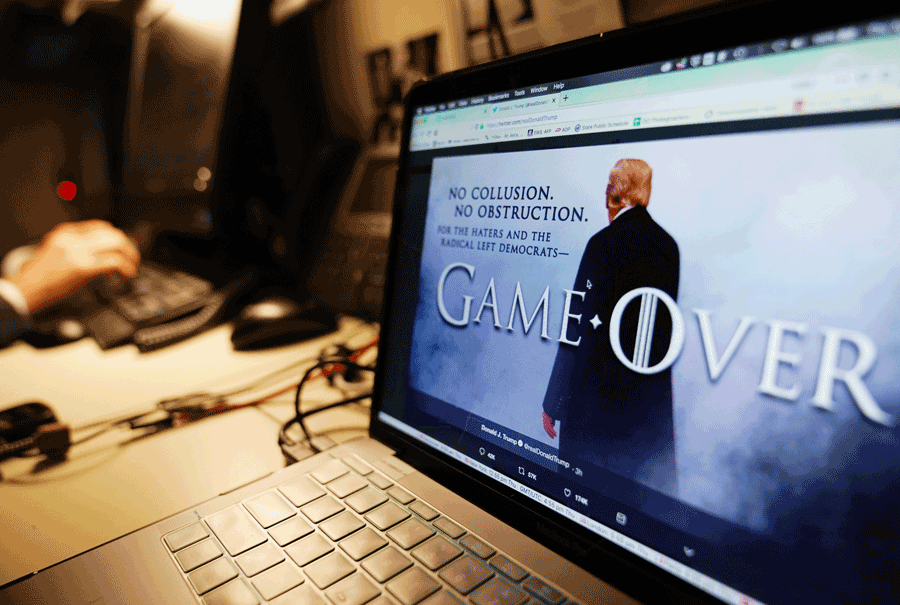
Donald Trump’s twitter page in Washington, DC using a
 Game of Thrones-styled montage. In April 2019  the 
US President tweeted “Game Over” declaring himself fully vindicated
 in the 
investigation into 
Russian election meddling and alleged collusion in the 2016 
presidential elections.
With the advent of the Trumpian age, we have been introduced to what one may call post-modern diplomacy. If Trump were to be taken as an example, our diplomat would have to be brash, rude and blunt. He could stoop to any depths to draw attention. This being the age of technology-driven communication, the interaction is fast and widely publicised.


Since changes have come rapidly, there has been no time to draw up a code of conduct to regulate the application of new technologies to the workings of governments. As a result, international relations operate in a jungle of tweets in the mayhem of Facebook and a 24/7 television cycle.
Previously the key feature of the international system was that it allowed sovereign states to conduct relations  within a universally recognised legal framework – initially informal and then codified with the passage of time.
Numerous treaties and conventions, starting with the Congress of Vienna in 1815,  were negotiated. The  most significant one that regulates diplomatic relations today is the Vienna Convention on Diplomatic Intercourse and Immunities that came into force in 1964. It formalised the principle that diplomats need security and confidentiality to perform their function of communicating with their home country and negotiating with foreign states without being pressurised.


So sacrosanct has been the right to privacy and secrecy  of a diplomat that governments have gone out of their way to prevent any breach of this principle. They are generally discreet and avoid hasty disclosures. These are traditionally  regarded as the forte of a good diplomat.
Some of this changed when the CNN entered the media scene. Press counsellors had to constantly dodge reporters that were hovering around. Even if they managed to evade media attention, they could not stop the phenomenon of instant global reportage of events that affected their government, even before the Ambassador had managed to connect with his boss back home.
The major impact of the ubiquitous presence of television was that governments started losing the initiative on critical occasions and the compulsion to react immediately led to hasty decisions – ones that were not always wise. Remember Somalia’s civil war in the 1990s? The American forces  intervened there, as was their wont. In October 1993,  the Somali insurgents captured some American soldiers. The bound corpse of one of them was dragged brutally through the streets of Mogadishu and televised by the CNN. That was the turning point for President Bill Clinton’s Somalian policy. American troops were withdrawn within a few months.

With the advent of the Trumpian age, we have been introduced to what one may call post-modern diplomacy. If Trump were to be taken as an example, our diplomat would have to be brash, rude and blunt. He could stoop to any depths to  draw attention. This being the age of technology-driven communication, the interaction is fast and widely publicised. 

The Chinese are clever. They have mastered the art of silence to a degree that they get what they want without making a hullaballoo. When two Chinese women said to be running a massage parlour in Islamabad were abducted by the militants of Lal Masjid in 2007, there was no public protest from Beijing. But within a few days the Chinese women were recovered. However, not  all nations  have the patience and discipline of Confucius. Neither are all governments immune to public pressures as the Chinese are.
The debut of social media in the 21st century is another phenomenon that has had an impact on diplomacy. If used optimally and with integrity, it can become a rich source of information about the people and regions where a diplomat is based. Conversely, s/he can, in a way, engage with the public directly and influence opinion about the country s/he represents.

Trump’s colloquialisms go viral on social media in spite of his less than eloquent, and often nonsensical, sayings.


But there are caveats in ‘digital diplomacy,’ as it is now termed,  that diplomats have to be mindful of. The most important of these is the need for excellent communication skills in those who use social media. Then they must have the discretion to distinguish between what can go public and what should be left unsaid, as delicate negotiations still need confidentiality.
Some recent battles we have witnessed on Twitter are certainly not the best examples of public diplomacy [JB emphasis]. Take the case of President Donald Trump’s infamous  tweets on Pakistan on New Year’s Day in 2018. Early in the morning, he tweeted, “The United States has foolishly given Pakistan more than 33 billion dollars in aid over the last 15 years, and they have given us nothing but lies and deceit, thinking of our leaders as fools. They give safe havens to the terrorists we hunt in Afghanistan, with little help. No more!”
Trump could certainly have been discreet. Had he been so, he wouldn’t have had to subsequently swallow his tweets, thanking Pakistan for facilitating the Qatar talks between Zalmay Khalilzad and the Taliban.
Not to be  left behind, the American Ambassador in Kabul jumped into the fray recently, when Imran Khan spoke about an interim government in Kabul, which the Foreign Office in Islamabad said had been quoted out of context. But for His Excellency John Bass, the opportunity to take a  swipe at Prime Minister Khan was too good to be wasted. He tweeted, “Some aspects of cricket apply well in diplomacy, some do not. #Imran Khan, important to resist temptation to ball-tamper with the Afghanistan peace process and its internal affairs.”  As expected, this triggered off a reaction that was equally ungainly.
Ministers joined the battle. They remarked that America had no diplomatic skills, its  ignorance was not bliss and that Mr Bass was  a “little pygmy” (the last coming from the Human Rights Minister, Shireen Mazari). Other tweeters egged them on.
Is this what digital diplomacy is all about?  In that case, all states should wind up their Foreign Offices and rewrite the rules of international relations.
Zubeida Mustafa is a senior journalist. She writes on a variety of subjects but her interest has mainly been in the social sector which she has covered extensively. She has investigated in-depth issues such as education, health care, women̢۪s empowerment, children̢۪s rights and the lives of ordinary people.