Saturday, June 1, 2019

Malawakil Manama's Public Diplomacy Initiative


kln.gov.my


The Ambassador of Malaysia to the Kingdom of Bahrain, His Excellency Agus Salim bin Yusof, and his wife, Norsyazwani Hamdan, paid a visit to Bahrain’s main hospital, Salmaniya Hospital on 21 May 2019.  The purpose of the visit was to distribute gifts from the Embassy and PERWAKILAN Manama to more than 40 children in the paediatric ward of the Hospital, on the occasion of gergaoun (children’s traditional festival celebrated in mid-Ramadhan). The Embassy hopes that the gifts brought joy and happiness to the children who could not celebrate gergaoun with their families and friends. 
This first-ever initiative undertaken by the Embassy was one of the activities lined up to commemorate the 45th anniversary of diplomatic relations between Malaysia and the Kingdom of Bahrain this year. 

Ambassador of the Year & Public Diplomacy Awards 2019


Posted by  on Monday, May 27, 2019; Diplomat Magazine


On the occasion of the 2nd Canada’s Ambassador of the Year&Public Diplomacy Awards 2019, the Faculty of Civil and Common Law of the University of Ottawa, in collaboration with the Deanship of the Diplomatic Corps of Canada and the International Public Diplomacy [JB emphasis] Council by Diplomat Magazine, celebrated in March its Awards Ceremony, that was followed by a reception. 
The Award consisted in a Canadian Inukshuk sculpture, and it was presented by the Deans of the Faculties of Law and the Dean of the Diplomatic Corps. 
Twelve prizes went to heads of diplomatic missions from twelve geographical regions to 12 award-winning ambassadors. Moreover, four special awards and recognitions were handed to organizations working closely with the foreign missions present in Canada. Special prizes also went to distinguished individuals, including a High Special Diplomatic Recognition to H.E. Constant Horace, Dean of the Diplomatic Corps of Canada and Ambassador of Madagascar to Canada.


The 2019 Awards ceremony also featured the farewell to Ambassador Constant, who will be returning to his country, after serving thirteen years in Canada. Mr. Pierre Thibault, Assistant Dean of the Faculty of Civil Law, offered him a gift on behalf of the faculty.

The Dutch Council for Russian Compatriots elects a new Bureau.


diplomatmagazine.nl


Konstantin Makarenko, the Executive director of the Public Diplomacy [JB emphasis/underlining] Corps (PDC) Foundation named the priority for the current stage: “to change the principles of work”.
The Hague, 18th May 2019. TASS Correspondent Vitaly Chugin. 
A scheduled conference of the Coordination Council of Russian compatriots was held last Saturday in the Hague. The Conference elected a new Bureau and set out the goals and tasks for the near future.
When speaking to our TASS correspondent, Mr. Makarenko, the Executive director of the Public Diplomacy Corps (PDC) Foundation, who moderated the meeting, mentioned that the priority for the current stage is: “to change the principles of work”.
“Our organization needs a new working style”, said Mr. Makarenko. “In the past our activists reported on their own work results. Now we have built an internet portal which will publish the information on positive experience cases. People must know that such positive experience exists. But our Bureau needs to focus on comprehensive large scale projects. For example, each school can organize a festival. But no school can organize a large scale event where 300-400 students will participate”. As examples of such large scale events Mr. Makarenko named the celebration of the 75th anniversary of the Victory in the Great Patriotic War and the 350-year birthday of Tsar Peter the Great (1672-1725).
The freshly elected Bureau consists of 7 members. The Conference has also resolved to return to the old official name “The Coordination Council of Russian Compatriots in the Netherlands” and to offer the new version of the Statutes for public discussion.
Consolidation as priority
At the meeting were also present: Boris Zhilko, ChargĂ© d’affaires of the Russian Federation in the Netherlands, Andrey Lanchikov, the Deputy-Director of the Foreign Ministry Department for Relations with Compatriots living Abroad, Mr. Artyom Chernov from the Rossotrudnichestvo Agency, who is responsible for cooperation programs with compatriots abroad, as well as representatives of the Russian Embassy in the Netherlands.
In his speech Mr. Lanchikov passed the greeting from Mr. Oleg Malginov, the Director of his Department and the Secretary of the Governmental Committee for Compatriots living Abroad. This greeting underlines the “current need to consolidate the Russian diaspora, to create an atmosphere of good will and mutual support”. The Russian Foreign Affairs Department expects the renewed Dutch Coordination Council of Compatriots to address a broad spectrum of issues. Such as lessons of Russian for children, the preservation of Russian culture and traditions among compatriots, the development of economic ties with Russia as well as making the diaspora youth aware of historical memory and their Russian roots.
Mr. Lanchikov also referred to the last years’ 6th World Congress of Compatriots. “There were many discussions during the Congress. The proposed objectives are quite ambitious. You can use them as guidelines in your work. Do your best to implement them. I really hope that you will continue to build on the constructive cooperation with the Russian Embassy in the Netherlands. Only together we can move forward.”
Yury Uraksin, the First Secretary of the Russian Embassy in the Netherlands has invited the newly elected Bureau to cooperate with all stakeholders. “No one should be ever excluded from our activities” underlined Mr. Uraksin. “Inclusivity is THE way to guarantee the best results for the whole coordination committee”. The diplomat has also stressed the need to use the positive experience of the past. He promised all possible help and cooperation on behalf of the Embassy to further consolidate the compatriots in the Netherlands.

Global Media Giants Meet to Debate Their Future and Challenges Ahead in the 21st Century


Alan Heil, Public Diplomacy Council, May 20, 2019
It was perhaps the largest gathering of public diplomacy advocates and international broadcasters and media scholars ever held in America. The U.S. Agency for Global Media (USAGM) organized a day-long conference May 7 at the U.S. Institute of Peace in an atrium within sight of the Lincoln Memorial.
Bearded old man
Senator Ted Cruz (R-Texas).
Highlight of the day: an address by Senator Ted Cruz (R-Texas), a new member of the Senate Foreign Relations Committee who eloquently summarized the role of America’s free press and expanding avenues worldwide for defending truth in journalism.
As Senator Cruz put it: “Our principles can tear down walls, can topple tyrannies, can promote freedom. America should consistently be a voice for freedom. We should be a voice for human rights. We should be a voice for democracy, because that truth is powerful and it can transform the world.
“That’s also where an American free press and the USAGM come into play. Now to be clear, we don’t ask journalists to promote the viewpoint of the United States government. There are plenty of countries in the world where governments run their media and the media is little more than a propaganda outlet for whatever the policy views are of particular regime in power.
“Instead,” Senator Cruz added, “we believe in a different kind of press, one that aligns with American principles. It’s a testament to our system of government that we encourage and protest dissent. That we encourage and protect a free media because freedom depends upon a free media.”
More than a hundred representatives of global multimedia broadcasters and scholars attended the Media for Democracy Forum to exchange ideas about strengthening “truth power” in a digital age. All five taxpayer-funded international overseas networks were represented: Voice of America (VOA), Radio Free Europe/Radio Liberty (RFE/RL), Radio Free Asia (RFA), the Middle East Broadcasting Network in Arabic (MBN), and Radio-TV Marti (OCB) in Spanish to Cuba.
Other media, governmental and civil society organizations participated, as well, including the National Endowment for Democracy, The Atlantic Council, Freedom House, IREX, Deutsche Welle, CNN, the Hudson Institute, the University of Southern California, the State and Defense Departments and USAID.
CEO John Lansing of the USAGM (until recently known as the Broadcasting Board of Governors) introduced Senator Cruz and noted: “Like defense, development and diplomacy, U.S. international media (the five networks listed above) are an essential part of our standing on the world stage.” He noted that these networks reach a combined multimedia audience in 100 countries totaling 345,000,000.

Principal points made by panelists during the Media for Democratic Freedom (M4DF) conference:

  • “Between 2009 and 2019, there was more change in media delivery systems than in the preceding four decades. Let’s think seriously about the digital divide. We have to be aware of the potential of new media and its impact.” — Alec Ross, author of the global best seller, The Industries of the Future. The book has been translated into 24 languages and explores the worldwide technological and economic trends of the coming decade relevant to media and human development.
  • “Both Russia and China have invested in shaping the media of other countries, particularly in Central Europe and Latin America. Fifty three percent of users in an electronic poll feel that press freedom will decline, worldwide in the next 10 years.” — Chris Walker, vice president of the National Endowment for Democracy.
  • “We need to watch what works. Because of our broadcasts, Venezuela’s Maduro is aware of what has been happening in Myanmar (Burma) which expelled the Rohingyas and in Iran during huge anti-government protests early last year. Our audiences in China have gone up, and VOA’s Charter has held up remarkably well over the years.” — Amanda Bennett, Director, VOA, and two time Pulitzer Prize winning journalist in leading U.S. daily newspapers.

    VOA director, Amanda Bennett, spoke at the PDC’s First Monday Forum on May 6, 2019.
  • “In Asia, the worst offenders are China and North Korea. Six of our reporters in northwest China follow closely what Beijing calls ‘re-education camps’ for an estimated one million Uighurs accused of anti-regime activities. PRC media threaten those reporters’ families who live in the U.S. This global shaping space matters. For international broadcasters, freedom is not free — it demands investment by all of us.” — Libby Liu, President, Radio Free Asia.
  • “RFE/RL can be an example. The U.S. government can encourage non-government organizations to help identify and neutralize media organizations of hostile opponents. Our programs to Ukraine are on two major networks there with an estimated two to three million viewers. They can also watch our programming stream on YouTube and Facebook.”— Natalia Sedletska, author and host, RFE/RL investigative TV program, Schemes.
  • “We have detailed info on the media of 200 countries. I think we all agree here that China has the most sophisticated disinformation media. In Russia, we’ve seen them rolling out wave after wave of new attacks against open media. We try to counsel on ways of countering network censorship.” — Arturo Filasto, founder of the Open Observatory of Network Interference (OONI), a project monitoring internet censorship and network interference globally.
  • “It was our Constitution’s First Amendment that talks about a free press. If you lose this, you lose everything else.” — U.S. Representative Chris Stewart (R-Utah), of the House Appropriations and Intelligence Committees and New York Times No. 1 best-selling author of Seven Miracles That Saved America and The Miracle of Freedom: Seven Tipping Points That Saved the World.

Ronald Reagan speaking in front of the Brandenburg Gate and the Berlin Wall on June 12, 1987. Official White House photo.
In wrapping up the conference, USAGM consultant and former NBC President and former CBS News Executive Editor and Producer Steve Capus told a story that sums up what a free press means to geopolitics in any age: “In my office, the dominant feature is a gigantic painting of President Ronald Reagan standing before the Brandenburg Gate (in Berlin) saying the words: ‘Mr. Gorbachev, tear down this wall!’ Many don’t know the back story behind those words. I believe those are the most important words uttered by any leader in modern times.
“The back story is that three times, the State Department edited those words out of the speech. And three times Reagan, with his own hands, wrote them back (in). And they proceeded to have arguments where the State Department said, ‘Mr. President, you can’t say this. Mr. President, it’s too belligerent. Mr. President, this is unrealistic. We know that the Berlin Wall will stand for all eternity. So you cannot say something like this.
“And each time, Reagan wrote it back in and said with a smile: ‘You don’t understand. This is the whole point of the speech.’ And just a few years after those words were uttered, the Berlin Wall was torn to the ground. That’s important to reflect on. The United States didn’t bomb the Berlin Wall. We didn’t send tanks in to demolish it. It was simply the words, the power of speaking the truth. And tyrannies fear truth…”
It turned out that Mr. Capus had the last word at the USAGM conference: “And finally, your mission is to connect people. Many of your outlets,” he concluded, “are broadcasting to places of alienation and isolation. In too many of these places, people have lost hope. And the work you do is invaluable in bringing news of a different world. Speaking to power, speaking to oppression, speaking for freedom, speaking for human rights is powerful. And it is at the very core of your mission. So for that, I simply say, ‘Thank you.’ ”

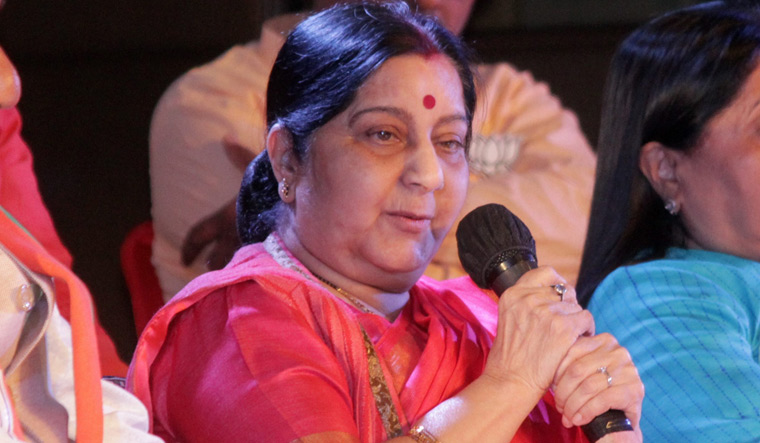
Sushma Swaraj, the minister who brought a human touch to MEA


Rekha Dixit, Mandira Nayar, theweek.in, June 1, 2029; on Swaraj's exist as Foreign Minister, see

Sushma Swaraj explains why she prefixed 'chowkidar' to her name
The diminutive leader leaves behind very big shoes to fill in (image from article)

Indian diplomats in overseas missions had taken to sleeping with their cellphones switched on. Sushma Swaraj, the former external affairs minister (EAM), had the habit of calling—regardless of the time difference—if she got a tweet or heard that an Indian was in distress. Overnight, the ministry of external affairs (MEA), which had earlier left public diplomacy [JB emphasis] to the ministry of overseas Indian affairs (MOIA), had to become much more hands on. The MOIA, not surprisingly, was soon dissolved and subsumed by the MEA. “I do not sleep. I do not let Indian envoys sleep,'' quipped Swaraj at a press conference once. But it was more than just a light-hearted remark. It was the way she worked. And it will be this personalised stamp of diplomacy which will be missed at the ministry, missions, and international interactions.
There were no interviews for the press. But she was available to the aam Indian, even during the times of her illness. Swaraj once said: “We have worked to integrate people's policy into the foreign policy... Ask those Indians who are stuck in foreign lands.” This has been one of her biggest achievements, the transformation of a ministry that so far remained focused on diplomacy—and viewed as aloof—to become more people oriented. Swaraj became the patron saint of the stranded Indian. It was her efforts which brought back the deaf-mute Gita from Pakistan, and later, Uzma, too, who escaped a bad marriage and captivity. Then there was Gurpreet, the victim of an abusive marriage, who found herself in a German refugee camp. Gurpreet reached out to the minister over social media, and was soon brought home. While these women became Hindistan ki betiyaan, Swaraj, morphed into the benevolent Bharat Mata herself.
It helped that Prime Minister Narendra Modi's vision included the non-resident Indian. The Madison Garden event had proven that he had a rockstar image. The NRI was no longer distant. He was the loudest cheerleader of the Modi government. But more than just a Swaraj idea, the muscular Indian government has been at the heart of the Modi doctrine. “Indians abroad are a huge asset for the country, whether in the economy, in image or in influence,’’ said Swaraj at a book release function in 2016. She spent the rest of her term, ensuring that Indians abroad feel this importance. “Another method of expressing that is to give them the comfort that the government is always there for them. That is the least we can do for our nationals who do so much for us,’’ she said.
Turning social networking into a power tool, Swaraj quickly won hearts and minds. She tweeted on her own. And despite all the rescue and crisis management she affected over her tweets, she always had time for a joke. Once, someone asked her whether it was safe to travel to Bali, and she tweeted, tongue in cheek, that she would consult the volcano and revert. One of her early tweets to go viral was in response to the disgruntled owner of a Samsung refrigerator. She tweeted: “Brother, I cannot help you in matters of refrigerator. I am very busy with human beings in distress.”
It was no surprise that she had one of the largest followings among politicians on social media. In a country where foreign policy is dominated by the prime minister, Swaraj brought something special to the post of EAM.
It wasn't only the stranded Indian. Swaraj facilitated travel permits to many who sought medical visas. In one of her last interventions, she sought information on why Friederike Irina Bruning's visa had been denied. Bruning, a Padma awardee, was threatening to return her award. Swaraj's outreach legacy will continue, largely because she institutionalised it.
In 2016, the MEA generated Twitter seva service to ensure that no one is left out. The application tracks the concerns or complaints and redirects it to the official concerned who handles the grievance or the issue concerned, and responds either on Twitter or offline. The first tweet by the new foreign minister, S. Jaishankar, assured all Indians, that “Team MEAIndia'' will “continue to be at your service 24X7''. And in true form, Jaishankar, appreciated the quick action the embassy in Riyadh that had reached out to a distressed Indian worker who needed to go back home urgently.
Indian diplomacy will miss her warmth and wit. She knew the names of everyone who worked under her. She was accessible. As one official quipped, “We know we will get an appointment if we ask.” More than her bonds within the ministry, Swaraj, who had worked for years in Parliament and was skilled at building bridges with the opposition, will be missed by her peers in other countries. On first-name terms with most leaders, she enjoyed a great rapport with them. She refers to herself and John Kerry, the then US secretary of state, as the long and short of diplomacy and is believed to be the only one who could give Wang Yi, the Chinese foreign minister, a 'talking to', sugar-coated of course.
Once she told KPS Oli Sharma, prime minister of Nepal, that India was the older brother in the neighbourhood, no doubt. But India was more the caring elder brother or bade bhaiya in the relationship, which was very different from the western concept of the bullying Big Brother. As the older sibling, India had the right and responsibility to care for the younger ones. Her successor could take a leaf out her her page in smoothening sharp edges of relationships.
Swaraj brought in the great Indian family ethos into her work approach. If she was Bharat Mata to the stranded, she was badi didi to world leaders younger to her.
Despite failing health, Swaraj would take personal interest in everything, even the arrangements for parties hosted by her. She celebrated International Women's Day in a big way, inviting women diplomats, government officers and women in media to be part of it. She would herself oversee even the decor and menu. And because she is vegetarian, she'd always ask the guests whether the non-vegetarian fare was up to the mark. It was the one thing she didn't decide.
The diminutive leader leaves behind very big shoes to fill in.

A New Path Ahead For U.S. Public Diplomacy Advocates In A Digital Age?

Alan Heil, Public Diplomacy Council, May 28, 2019

What is public diplomacy? [JB -- see also (1) (2) (3) (4)]

It’s a term used more widely than ever in the 21st century, as a leading scholar of the concept, the University of Southern California’s Professor Nicholas J. Cull explains: “Public diplomacy deals with the influence of public attitudes on the formation and execution of a nation’s foreign policies.”
Dr. Cull adds that PD encompasses dimensions of international relations beyond traditional diplomacy, including:
  • The formation of public opinion in other countries
  • The interaction of private groups in one country with those of another
  • The reporting of foreign affairs and its impact on policy
  • Communication between those whose job it is in various countries, including diplomats and foreign correspondents.
These themes reflect a wide range of intercultural communications, public and private, via cultural and educational exchanges with international visitors and US-funded global broadcasting.

What Are The Public Diplomacy Council (PDC) And The Public Diplomacy Association Of America (PDAA)?


PDC’s new president, Dr. Sherry Mueller, addresses the crowd at a First Monday Forum.
These two non-profit citizen volunteer groups headquartered in DC are exploring ways of supporting effective public diplomacy in unprecedented ways. Together, they have nearly 600 members, many of them retired foreign service officers or alumni of international communications organizations. This month, former PDC President Adam Clayton Powell III, who is also the director of the University of Southern California’s Washington office, and former PDAA President Ambassador Cynthia Efird are moving on from their non-governmental public diplomacy leadership posts. How have they strengthened a long-sought cooperative effort of both organizations? A number of US government alumni, including this writer, are members of both the PDC and PDAA.

Inspiring First Monday Forums

First Monday Forum participants
At a First Monday Forum, Executive Director Bob Heath chats with two attendees.
For the first time in 2017, the PDAA joined forces with the PDC and USC in co-sponsoring First Monday informal lunchtime roundtables at George Washington University’s School of International Affairs. These are led by expert public diplomacy advocates — private sector and government — at the beginning of each month. According to Adam Powell, there now have been nearly a hundred First Monday sessions since 2010. Attendance has now approached capacity crowds, including a growing number of GWU students.
Recent roundtable leaders have included:
  • U.S Peace Corps director Dr. Jody Olsen, who shared success stories from her organization’s volunteers in 64 countries as diverse as Albania, Gambia, Ghana, Guatemala, Macedonia  and even the People’s Republic of China.
  • Assistant Secretary of State for Educational and Cultural Affairs Marie Royce on American educational and cultural exchanges, in all their variety and richness, as they build person-to-person friendships globally.
  • Sister Cities International President Roger-Mark De Souza, who noted that “by sharing ideas with other countries’ municipal leaders, here and abroad, we help shape America’s foreign relations unofficially, one handshake at a time.”
  • VOA anchor Greta van Susteren, who produced an on-scene documentary, Displaced, reflecting the horrific conditions in a refugee displacement camp for Burma’s Rohingya refugees in neighboring Bangladesh.

Monthly Seminars with Mid-Level Foreign Service Officers


Former US Ambassador to North Macedonia Jess L. Baily discusses the Role of Public Diplomacy in Resolving the Greece-Macedonia Name Dispute. Photo by Hunter B. Martin.
As part of the Public Diplomacy Council’s continuing commitment to foster the people and practice of public diplomacy at the U.S. Department of State we work with two FSO volunteer co-chairs to sponsor informal seminars around a variety of professional themes.  The seminars provide an opportunity for mid-level public diplomacy officers, many of whom are on their first Washington tours and widely dispersed around the Department, to meet each other, discuss professional and policy issues, learn about different types of public diplomacy assignments and consult with senior or retired officers in an informal setting.  Themes for discussion are chosen by the 30-50 FSOs who regularly participate and expert speakers are invited to address the contributions of public diplomacy to critical U.S. Department’s foreign policy challenges.  The PDC provides lunch; the American Foreign Service Association (AFSA) kindly provides a conference room at their headquarters.

PDAA Annual Awards to Recognize Public Diplomacy Successes

PDAA works with the Office of the Under Secretary for Public Diplomacy and Public Affairs to recognize annually outstanding public diplomacy efforts. The awards have gone to foreign service,  civil service, and locally employed staff, both overseas and in the U.S. A worldwide cable solicits nominations for innovation in serving U.S. policy objectives through a range of public diplomacy tools. The winners each year receive a certificate, a cash prize, a year’s membership to PDAA, and are honored at an annual brunch.
To fund the award program, PDAA raises money throughout the year, as well as contributing some funding from membership dues. This year on May 5 at the Army-Navy Club in Washington, DC, four awards were given:
  • Niles  Cole, CAO Kampala, received  an award for reaching 32 schools in 15 districts with the bus “Explorer Lab,” equipped with computers  and encouraging learning  through problem solving. The students’ interest led to the government purchasing US air quality equipment and drafting new environment regulations.
  • Christopher Hodges, PAO in the Palestinian Affairs Unit, US Embassy Jerusalem received his award for  extraordinary leadership during a period of low public opinion of US policy. He maintained effective contacts and shaped messaging through media interviews in fluent Arabic.
  • Natella Svistunova, PAO US Embassy Belmopan was awarded for an innovative plan to combat gender violence. She designed a  successful media campaign to create an  anti-violence label for a sauce. The product with the label was rolled out in an event attended by the Prime Minister’s spouse and family, engendering Belize-wide attention.
  • Debra Torbiong, Public Affairs Specialist at U.S.  Embassy  Koror  in Palau. She was cited by the Ambassador for a program that redesigned the Palau school lunch program and encouraged healthy eating and exercising. The Ambassador said she promoted health and food security through an “innovative, responsive , interactive and effective” campaign. Both Svistunova and Torbiong were present to receive their awards. The others were accepted by representatives from the respective geographic regional offices.

Coordination Initiatives Continue


Adam Clayton Powell III greets Roger-Mark De Souza, president of Sister Cities International, at the First Monday Forum Speaker on Feb. 11.
I asked USC scholar Adam Clayton Powell how he first became interested in public diplomacy. He has headed USC’s Washington office for more than a decade. He wanted to move to DC from California in 2010 and asked the former USC president, Max Nikias, what the office assignment here entailed.  President Nikias replied: “Connect the links.”
That meant from USC’s perspective, enhancing the contacts between the separate PD-related organizations in the nation’s capital: the Council (primarily an advocacy group in U.S. media and on Capitol Hill) and the Association (focused on perfecting public diplomacy practice in State and at missions overseas). Another key goal was to share knowledge about PD practices with newly-named FSOs and to encourage them to value 21st media vehicles (listening and viewing as well as counseling) as their careers are built. Adam Powell offered one example in “connecting the links”: an introductory seminar for new FSOs entitled: “What do expect to happen in your first day at your first overseas post?”
The PDC and PDAA continue to increase their links.
All those interested in the activities I mentioned above can learn more on their new, shared website at www.publicdiplomacy.org. There, you can learn about all the initiatives of both PDC and PDAA, which are expanding programs that are available to members of both organizations.
Cynthia and Panel
Ambassador Cynthia Efird addresses the crowd at a First Monday Forum.
The PDAA’s former president Efird reports that its board last month voted to “request the PDC to form a joint exploratory group with it to look at how to move further on closer cooperation, keeping in mind the organizational legal and other issues both memberships might have. “Cooperation,” she added, “is a work in progress, but a work that could be important in securing the health of both organizations and increasing the understanding of public diplomacy among our memberships and in a wider audience, as well.”
Two veteran public diplomacy advocates and nominees to succeed as presidents of the PDC and PDAA, Dr. Sherry Mueller of the Council and Jan Brambilla of the Association, appear to recognize the importance of sustaining the unprecedented contributions of their two predecessors.  Dr. Mueller, former President of Global Ties U.S. is a professor teaching cultural diplomacy at American University and Jan Brambilla is a longtime member of PDAA and a former distinguished personnel director at VOA.
I submit that the late great journalist and head of the former U.S. Information Agency, Edward R. Murrow, once offered a perfect prescription for public diplomacy all might easily agree on:  “To be persuasive, we must be believable.  To be believable, we must be credible.  To be credible, we must be truthful.  It is as simple as that.”

Russian sharp power targeting the European elections in Central-Eastern Europe


euromaidanpress.com, 2019/06/01


Image from article: Vladimir Putin (left) with Victor Orban, one of the pro-Russian politicians in the Central-East European regoin. Photo: wikipedia 


Article by: Lóránt Győri and Péter Krekó
While much attention has been paid in the international media to the abilities of the Kremlin to influence foreign elections, relatively little is known about why and how everyday citizens resonate to these attempts in post-communist countries of Central-Eastern Europe. Political Capital, therefore, explored the vulnerability and resilience to Russian hostile influence by focusing on the horizontal, online “grassroots” communication between citizens. Our research revealed not only the basic societal drivers behind these influence operations but how these came into play during the 2019 European elections campaign in the Czech Republic, Slovakia, and Hungary.
International polling, such as Pew’s 2018 research, has been proving the failure of Russian “soft power” since Russia invaded Crimea in 2014. According to Pew, just 34% and 26% of the global public (covering 25 countries) expressed a favourable view of Russia or President Putin respectively. Similarly, only a fraction of the population of the V4 countries (3-13%) would consider themselves as “part of the East” culturally or politically based on the Globsec Trends 2018 data in Central-Eastern Europe. So, we can quite confidently say that Russian “soft power” or the “weaponization of culture” that relies on cultural and political appeal, the beauty of Mother Russia’s landscapes etc. is failing, despite the Kremlin’s expansive and expensive international media empire (RT, Sputnik) and their local media clones’ presence in Europe.

The rise of Russia’s “sharp power”

Instead, our research proved the significance of the Kremlin’s so-called “sharp power,” one’s ability to influence and manipulate the geopolitical perceptions of foreign target audiences through feeding them negative or positive messages, disinformation.
Compared to hard power based on military or economic means or soft power mostly relying on public diplomacy [JB emphasis] and culture, sharp power tries to make the Kremlin and Russia look bigger, better, stronger on the world stage, a force to reckon with among great powers such as the USA or China.
Political Capital’s big data research in cooperation with Bakamo.Social has revealed that the formula has worked excellently in the Czech Republic, Hungary, and Slovakia. An explicit aim of the research was to leave behind the “elitist,” top-down approach of analyses on hybrid warfare and investigate ordinary conversations, so BakamoSocial’s social listening methodology mapped millions of “natural,” spontaneous online conversations of average citizens related to Russia or the Kremlin in a two-year period (between 20 November 2016 and 19 November 2018).

The number of conversations sampled in the three countries between 20 November 2016 and 19 November 2018
Based on our research data, the Kremlin’s perceived international “omnipotence” could be confirmed by “folk perceptions” in the three countries under revision. Although, the majority of online conversations related to Russia were either negative (46% of messages) or neutral (33% of messages), the two leading views in each country attributed direct and unrealistic influence to the Kremlin as a military “aggressor” or an “invisible manipulator,” capable to spying on people and/or changing their minds on certain issues.

The six basic perceptions about Russia and their representation in the three countries
Hungarian people seemed to be the most charmed by Russian influence and looking to the Kremlin as a “strong protector” (10%), which reflects the positive and uncritical approach of the Hungarian government to Hungarian-Russian bilateral relations. Moreover, we could identify “consumer groups” of Russia-related news or disinformation.
Around the third or 30% of each society belongs to three pro-Russian consumer groups or public segments with markedly different profiles in their relation to Russian sharp power.
The group we called “Russian fan boys” (10% of the sample) is receptive primarily to the masculinity and militarism of the Kremlin and Vladimir Putin; the group of “admirers of Russia” (10%) is more interested in high culture and the Soviet legacy. The third consumer group with positive attitudes was labeled “Russia is the safer bet than the West” (8%). They interpret Russia’ role in pragmatic economic and political terms based on Russia’s geopolitical proximity and economic or military power, so they provide a fertile ground for anti-sanctions rhetoric.
Russian fanboys are easily found among Eastern European and European far-right parties or paramilitary organizations maintaining excellent political relations with the Kremlin, while Soviet nostalgia is typically present among the older generations who spent their youth in the communist era and were especially hard hit by the economic outfall of the democratic transitions in the 1990s.
We also revealed a regional or Central-European pattern and basic drivers of the Russian sharp power. Foreign authoritarian influence in the CEE is strengthened by three main societal factors connected to the region’s geopolitical crisis.
First, there is a pro-Russian political elite, such as Hungarian Prime Minister Viktor Orban or Czech President Milos Zeman, Slovak far-right leader Marian Kotleba, who overestimate the significance or influence of the Kremlin for their own political or financial interests and whose rhetoric is echoed by Russian or pro-Russian media throughout the region. Second, specific ideologies, such as Pan-Slavic historical narratives in Slovakia or the Czech Republic, Soviet nostalgia in Hungary, create special bonds between Russia and Central-Eastern European societies. Finally, Eurosceptic rhetoric against Brussels makes Russia look like as an alternative power, partner to turn to preserve “national sovereignty” or escape the “colonization” efforts of the European Union.

Russian sharp power in the European elections

The monitoring of the current European elections campaign (by Political Capital, Globsec Policy Institute and Prague Security Studies Institute) has proven the interplay of these drivers of Russian sharp power.
Most of the pro-Russian disinformation narratives disseminated by local pro-Russian media networks in the Czech Republic, Hungary and Slovakia centered around the issue of “immigration” to highlight the Eurosceptic political players nationalist and anti-Brussels political platforms.
On the one hand, disinformation framed the European Union as some sort of a non-democratic “monster” crushing national identities, for instance, Sputnik CZ quoted SPD representative Radim Fiala’ parallel between the EU and the Soviet invasion of Czechoslovakia in 1968, or forcing Hungarians to abandon their Christian faith and traditions in favour of Muslim mass migration allegedly “enabled” by Brussels.
On the other hand, the Kremlin clearly supported the new far-right and pro-Russian political group titled Alliance of Peoples and Nations (EAPN) to be established by Matteo Salvini (League Party) and Marine Le Pen (National Rally Party) in the new European Parliament – an initiative that would welcome PM Orbán and his Fidesz-KDNP ruling coalition as well. Different narratives about the Union’s responsibility for immigration and related conspiracy theories all contribute to the EU’s negative issues, as seen on the chart below.

Dominant types of Eurosceptic narratives on the monitored Hungarian pages over time
While anti-Russian attitudes and narratives are still dominating the political discourses in the Czech Republic, Slovakia, and Hungary, research pointed to the fragility of this kind of societal resilience to Russian sharp power. Russia’s image is shaped by a relatively small minority of active users that amount to only 30-60,000 users or opinion leaders in each of the three countries we examined. Consequently, it would take only a small effort to fundamentally change the current anti-Russian perceptions in the CEE. More importantly, Russian sharp power already has the ability to circumvent the official communication channels via the existing, strong pro-Russian discussions and consumer groups on the grassroots levels of everyday communication.
Disclaimer
The authors are grateful for the generous support of the National Endowment for Democracy that made these researches possible. For more on Russian sharp power in the CEE see Political Capital’s dedicated website.
Lorant Gyori is a sociologist and political analyst, with a masters in social sciences from Eötvös Loránd University, Budapest, where he is currently working as a geopolitical analyst for the Political Capital think-tank on issues such as Russian soft powerdisinformation, and populism in Europe.
PĂ©ter KrekĂł is a social psychologist and political scientist. He has been the executive director of Political Capital since 2011. During 2016-2017, he worked as a Fulbright Visiting Professor in the United States at the Central Eurasian Studies Department of Indiana University. He focuses on Russian ‘soft power’ policies and political populism and extremism in Europe. His publications include a book on The Hungarian Far Right, and another one on the phenomena of fake news and conspiracy theories.

Read also: