Deputy Secretary of State Tony Blinken addresses the Afghan delegation at a U.S. Department of State.
“The history and values of United States are very different. Americans are adaptable to diverse cultures and they are very advanced, most people are qualified and there are so many new things to learn that it is hard to absorb everything in two weeks.”
These were the general remarks of 15 young Afghan diplomats who visited Washington DC and New York last month to participate in a two-week training program focusing on diplomatic craft and management skills. The Afghan Diplomats Training Program is sponsored by the U.S. Department of State and the Chinese Ministry of Foreign Affairs and, later this month, the group looks forward to a continuation of their program in China.
Meridian International Center, in partnership with the Public Diplomacy Council, developed the program to provide the delegates with a strong understanding of diplomatic process and requisite protocol, including employing proper terminology and drafting diplomatic correspondence. The 15 early-career English-speaking diplomats learnt how to set and prioritize national goals and become familiar with strategic planning, policy formation, and embassy management, including budgeting and allocation of resources. The participants also practiced effective negotiation and learnt to work with local, regional, and international media, including the use of new media such as social networking.
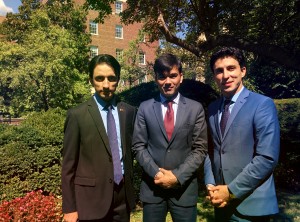
Participants of Afghan Diplomats Training pose for a photograph at Meridian International Center.
Omid Jalali, 28, felt that not only the lifestyle of Americans is different from the Afghan people but also the way government entities work is very advanced, dynamic and efficient. He termed this program an eye-opener for him as he found people in the U.S. much different than what he used to think about them. “They are very hospitable, cooperative and eager to learn about us. Though American culture is totally different but still it is based on the same values – respect, dignity and mutual collaboration for public good,” he added.
Sayed Abdul Habib Raihan, 29, is very impressed by the new technologies and techniques being employed in the United States for effective public diplomacy. It is very interesting for him to learn ways to formulate and conduct foreign policy including the role of stakeholders within and outside of the government. He also liked the format of training which included seminars, training exercises, hands-on simulations and site visits to give them the opportunity to take their theoretical knowledge and compare it to the actual, practical work of American diplomats. “The U.S. government and the State Department are very huge, much bigger than my country. It is very obvious that the U.S. invests more resources on public diplomacy to advance its relations with the world,” he added.
“I was very excited to visit the U.S. Department of State where I met Deputy Secretary of State Tony Blinken, Chinese Ambassador to the U.S. Cui Tiankai and Afghan Ambassador to the U.S. Hamdullah Mohib. This program has given me opportunities to improve my communication skills, learn techniques to collaborate and strengthen relations with the American people and officials,” said Omid Kamal, 24, who was also keen to know about the U.S. policy toward Afghanistan and South and Central Asia, U.S.-Chinese relations and the New Silk Road Initiative.
Abdul Karim Naqashbandzada, 32, recalled the trainings on mapping messaging and effective negotiations and termed them very useful for his professional growth. “Now, I know why it is important to learn messaging techniques for public and media engagement and the use of social media for diplomatic communications, including foreign ministry/embassy/inter-ministerial communications, public diplomacy, demarches and reporting. The discussions on embassy management, the role of country team personnel, embassy operations, hosting official visitors, strategic planning, and budgeting and resource allocation were very useful for me.”
The participants were quite confident that they will be able to apply these new skills upon their return to Afghanistan and it will not only improve their performance in terms of protocol, bilateral negotiations, consular operations, economic statecraft, trade and diplomacy, but their colleagues will also benefit from it as they will be sharing their lessons and experiences with them. The role of human rights in foreign policy, including the freedom of religion, was termed by a majority of participants as the most challenging issue that needs to be addressed in Afghanistan.
A Princeton PhD, was a U.S. diplomat for over 20 years, mostly in Central/Eastern Europe, and was promoted to the Senior Foreign Service in 1997. After leaving the State Department in 2003 to express strong reservations about the planned U.S. invasion of Iraq, he shared ideas with Georgetown University students on the tension between propaganda and public diplomacy. He has given talks on "E Pluribus Unum? What Keeps the United States United" to participants in the "Open World" program. Among Brown’s many articles is his latest piece, “Janus-Faced Public Diplomacy: Creel and Lippmann During the Great War,” now online. He is the compiler (with S. Grant) of The Russian Empire and the USSR: A Guide to Manuscripts and Archival Materials in the United States (also online). In the past century, he served as an editor/translator of a joint U.S.-Soviet publication of archival materials, The United States and Russia: The Beginning of Relations,1765-1815. His approach to "scholarly" aspirations is poetically summarized by Goethe: "Gray, my friend, is every theory, but green is the tree of life."



No comments:
Post a Comment